Sativa vs indica: the main differences explained
Have you ever wondered what the difference is between indica and sativa cannabis? These terms are used every day in the cannabis world, but what they really mean may surprise you. Today on the Cannactiva blog, we explain the differences between indica and sativa, and how they shape the effects of each strain. Stay with us to the end, because it's one of the most fascinating topics in the cannabis world! And if you're looking for top-quality CBD flower, take a look at our guide to the best CBD buds, hand-picked by Cannactiva.
3 key takeaways
- Indica cannabis relaxes the body (the classic “couch-lock”, or sofa effect). Sativa stimulates the mind (a cerebral effect, or “head high”). Hybrids combine both.
- Traditionally, indica and sativa differ in origin (the Himalayas vs equatorial regions), morphology (short, compact plant vs tall, airy plant) and effects (physical relaxation vs mental stimulation).
- Indicas tend to have Kush, sweet and earthy aromas (profiles with myrcene, linalool, caryophyllene and humulene). Sativas lean towards citrus and Haze aromas (limonene, pinene, terpinolene and ocimene).
Indica vs sativa: the main differences
Origin, aroma and effect: these are the three key dimensions that set indica and sativa cannabis strains apart.
Feature | Indica 🛋️ | Sativa 🧠 |
|---|---|---|
Origin | Himalayas, Hindu Kush | Equatorial regions (Thailand, Mexico, Colombia) |
Aroma | Earthy, sweet, Kush, spicy | Citrus, Haze, diesel, pine |
Effect | Physical relaxation, sedation (the “couch-lock” or sofa effect) | Mental stimulation, energy, creativity (a cerebral effect, or “head high”) |
What effect are you after? Choose by effect
- I want relaxation, rest or calm → indica strains
- I want focus, energy or creativity → sativa strains
- I want a balance between body and mind → hybrid strains
What do indica and sativa mean?
For some people, the ideal would be that, when you buy cannabis flower, you could choose the strain based on the exact effect you want to experience when you consume it. That's why the names indica and sativa are used in cannabis shops to classify strains according to whether they give distinct physical or mental effects.
“Indica” strains are associated with physical effects: relaxation, relief from pain and anxiety, and help falling asleep. “Sativa” strains, on the other hand, produce more cerebral effects of euphoria and creativity.
The indica or sativa classification is useful as a guide, but it isn't perfect: the extensive hybridisation of today's cannabis and the influence of the minor cannabinoids (CBN, CBG, CBC, CBDV, THCV) and flavonoids present in each batch make it hard to predict the real effect from genetics alone.
What are the differences between indica and sativa?
Different origins and morphological traits
Indica strains
The theory goes that “indica” strains originated in the mountainous regions of the Himalayas, specifically in the Hindu Kush region (see our article on Hindu Kush). The physical traits attributed to indica strains are shorter plants with broad leaves, dense foliage and dense, tight buds (although, as we now know, that isn't the case: in reality, cannabis with quite different traits can also have relaxing effects). Their abundant resin explains why indicas have traditionally been the basis for making hash. Here we explain what hash is and how it's made.
The indica effect is a deep sense of relaxation and tranquillity. Picture yourself lying on the sofa, full of calm and inner peace.
INDICA-type strains | ||
|---|---|---|
Strain (genetics) | CBD | Aroma |
25% | 🌲 Sweet and earthy, with a resinous Kush base | |
23% | 🧀 Smooth cheese, with fruity and floral hints | |
25% | 🍦 Sweet biscuit with an earthy base | |
22% | 🦍 Deep and earthy, with wood and diesel |
Sativa strains
“Sativa” plants, on the other hand, are native to equatorial regions such as Mexico, Thailand and Colombia. Physically, they've been described as taller plants with narrower leaves and longer, airier buds (we now know this isn't the case either: cannabis with a different morphology can also give cerebral effects).
The sativa effect is more mental, euphoric and stimulating. Think of it as a spark that fires up your creativity and wakes up your motivation.
SATIVA-type strains | ||
|---|---|---|
Strain (genetics) | CBD | Aroma |
27% | 🍋 Citrus, floral and tropical, with a Haze base | |
26% | 🍪 Tropical and floral, with resin-laden buds | |
22% | 🍋 Vibrant citrus, like freshly cut lemon, with fine woody notes | |
23% | ⛽ Intense diesel, very resinous |
Finally, there are the so-called hybrid strains. They represent the perfect harmony between relaxation and motivation, and they have mixed qualities from both types. Many of today's hybrids descend from pioneering genetics such as Skunk, the first stable hybrid in the history of cannabis.
HYBRID-type strains | ||
|---|---|---|
Strain (genetics) | CBD | Aroma |
25% | 🍒 Fruity, like strawberry sweets, with a citrus and resinous base | |
24% | 🍇 Forest fruits and resin, with earthy hints | |
26% | 🫐 Sweet, fruity and resinous, with a Haze base | |
23% | 🍓 Ripe strawberry and fresh watermelon, dense and resinous | |
23% | 🌺 Sweet, fruity and tropical: peach, mango and pineapple | |
17% | 🌺 Sweet and tropical, with passion fruit and a Kush base | |
28% | 🥭 Tropical mango with a sweet, resinous base |
Today, we know that cannabis actually originated in Central Asia, possibly in the foothills of the Himalayas, as biological and biochemical evidence shows. The different physical traits described in the past for each origin are linked to the various crosses that had taken place in the different regions where the plant was grown.
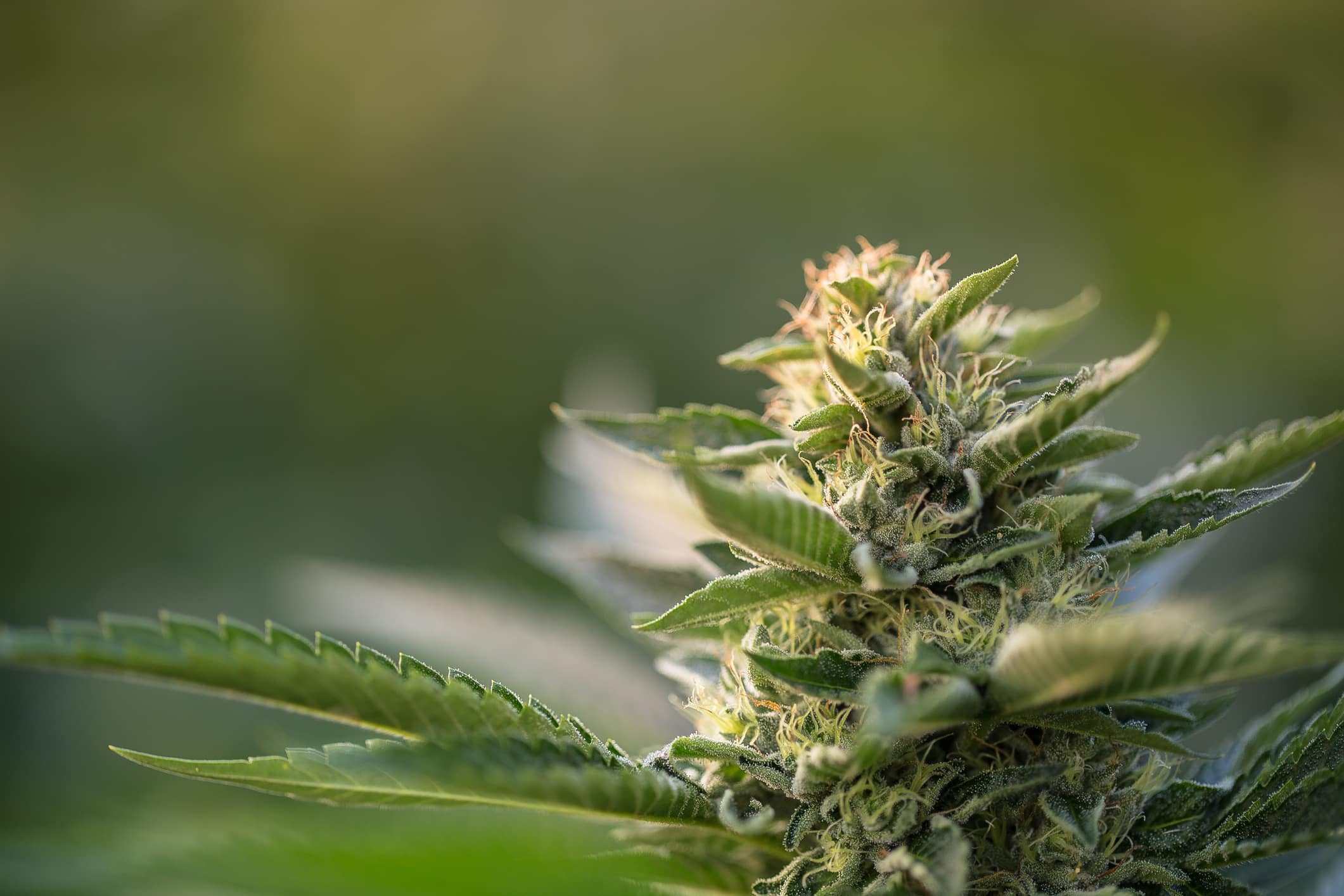
Today, breeding has hybridised cannabis to such an extent that telling indica from sativa by the appearance of the buds (their shape, colour or size) is almost impossible. That's why the “indica” and “sativa” labels refer to the effects of cannabis, not to distinct physical traits.
Chemical differences between indica and sativa: cannabinoids and terpenes
Where there is a real basis and consensus for classifying cannabis as having an “indica” or “sativa” effect is its chemical composition. The effects of cannabis vary depending on the specific terpene and cannabinoid profile of each strain.
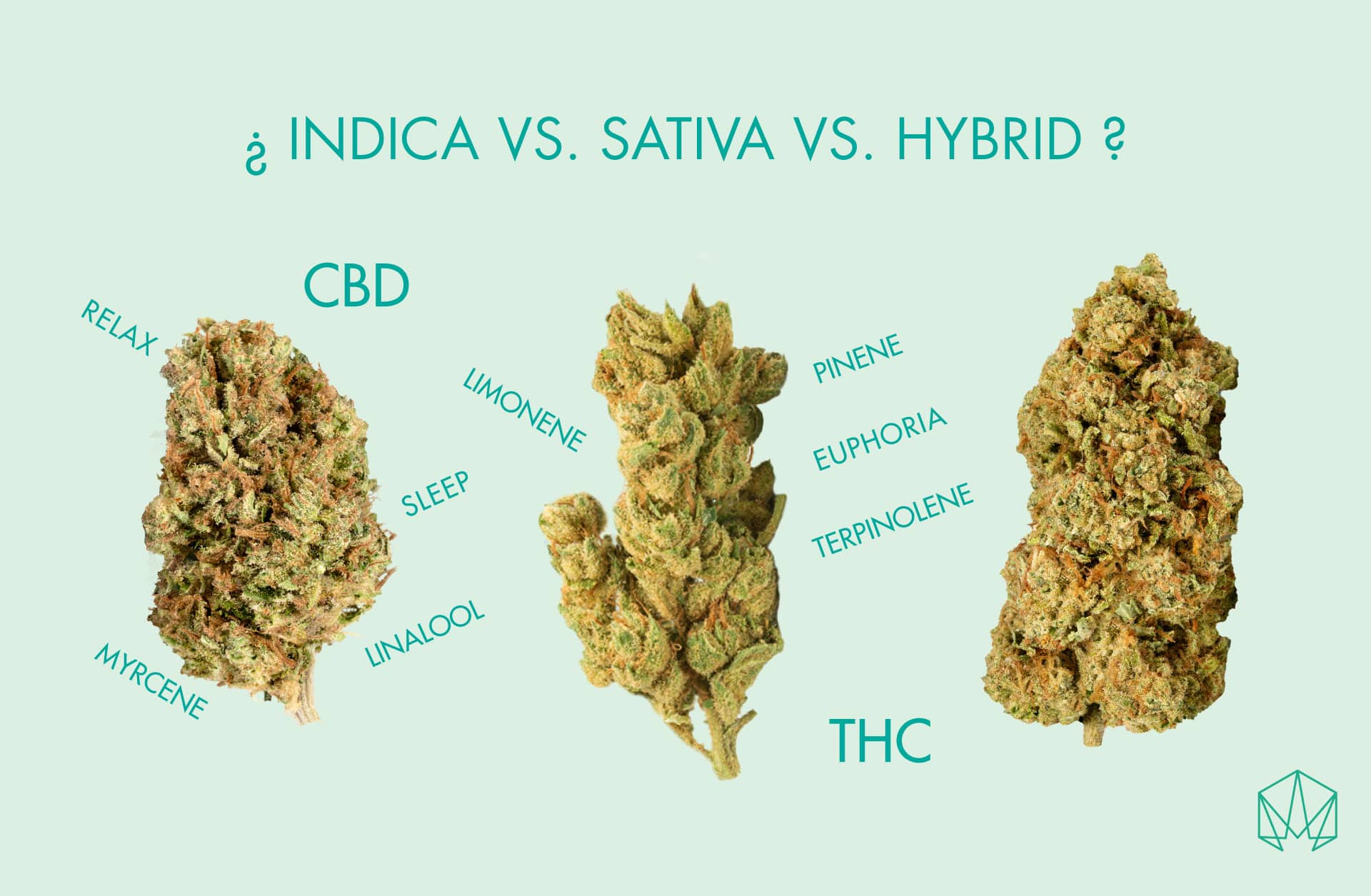
Indica strains tend to have moderate levels of CBD and sedating terpenes, especially myrcene (although others play a part too, such as linalool). These compounds provide a relaxing physical effect, which can help to ease stress, insomnia and body pain.
As for their tetrahydrocannabinol (THC) content (THC being the main psychoactive compound in cannabis), indicas usually have lower THC levels, or levels that are more balanced with CBD. This makes them less psychoactive, without intense euphoric or mental effects.
Sativa strains, on the other hand, tend to have higher levels of THC and stimulating terpenes, such as limonene, pinene and terpinolene. This contributes to their more euphoric cerebral effects and can help boost creativity, improve mood and fight fatigue. However, sativas with very high THC levels can cause intense psychoactive effects and may not suit everyone.
Myrcene is the most abundant terpene in cannabis and appears in almost every cannabis strain. What determines the indica or sativa effect is how much of it each strain contains and how it combines with other terpenes and with the minor cannabinoids present in the plant (such as CBN, CBG, CBC, CBDV or THCV), which also shape the final result.
Are CBD strains indica or sativa?
Cannabidiol (CBD) content doesn't determine whether a strain is indica or sativa. CBD is popularly associated with relaxing effects, but the traditional classification comes from the terpene and cannabinoid profile, not from cannabidiol. We'd like to quote the neurologist and renowned cannabis researcher Ethan Russo, who says (4):
“The supposed sedation of so-called indica cannabis strains is wrongly attributed to their CBD content, but in fact CBD is stimulating at low and moderate doses! Sedation in the most common Cannabis strains is largely due to their myrcene content, a terpene with a narcotic-like sedative effect. By contrast, a high limonene content will improve mood, while the presence of the terpene alpha-pinene may reduce the short-term memory impairment induced by THC.”
This shows that cannabinoids aren't the only thing that matters: terpenes also play a prominent, if not decisive, role in the “sativa” or “indica” effects of cannabis. This interaction between the plant's different compounds is known as the entourage effect of cannabis.
Aromas: can you tell indica from sativa by smell?
Cannabinoids have no smell at all, whereas terpenes are the aromatic compounds behind the flavour of our favourite strains.
The terpenes responsible for the indica effect tend to have earthy, sweet, spicy and floral aroma profiles, while sativa-effect strains produce terpenes that lean more towards citrus, pine and diesel... But only in theory. Not even the most experienced cannabis connoisseurs could tell an indica from a sativa by aroma alone.
To quote the smell scientist Avery Gilbert, every fragrance has its own intensity curve, and a blend of terpenes creates a distinct olfactory perception that can't easily be traced back to the smell of each individual terpene. This makes your nose an unreliable way to guess whether a bud is indica or sativa.
Indica and sativa uses: when should you choose each one?
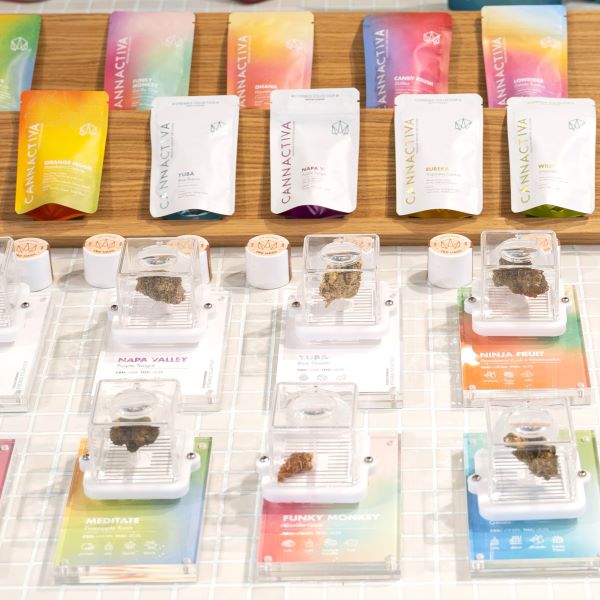
Indica strains are usually chosen when you're looking for physical relaxation, rest or calm, thanks to their terpene profile rich in myrcene and linalool. Sativas are the typical choice for moments of mental activation, focus or creativity, with limonene, pinene or terpinolene profiles. Hybrids combine both profiles and are the most versatile option for beginners or for anyone who wants an all-rounder. If you're looking for that relaxing effect without smoking, the most practical and easiest format to dose is sublingual CBD oil.
If you'd like to dig deeper, we have dedicated guides on CBD for insomnia and CBD for anxiety.
Two species: Cannabis sativa and Cannabis indica
The names “indica” and “sativa” are partly linked to the history of cannabis and its botanical name. Carl Linnaeus was the first to describe the cannabis plant grown in Europe, in 1753, which he named Cannabis sativa (sativa means “cultivation” or “cultivated”) (2). It was very tall and lanky, with few branches, and its uses included producing grain and fibre.
A few years later, in 1785, the botanist Jean-Baptiste Lamarck described what he believed was another species of the genus Cannabis, based on plants from India, which he named Cannabis indica (2). These plants looked more compact and rounded, with highly developed inflorescences (large buds).
We now know that the main difference between the cannabis plants described by Linnaeus and Lamarck at the time comes down to the different uses the plant was put to: fibre, or flowers and resin. It was later established that, botanically, there is only one species of cannabis: Cannabis sativa, which includes both plants. This classification still stands today, although it's somewhat controversial, and some taxonomists include subspecies such as sativa, indica, ruderalis and afghanica (or kafiristanica).
The key takeaway is that “indica” or “sativa” refers only to the plant's effects, not to its botanical name.
Flowering time and growing methods
Indica strains come from cold mountainous regions, have shorter flowering times and are best suited to indoor growing. Sativas, adapted to warm, tropical climates, have developed greater height and narrow leaves that protect them against mould and pests, which makes them the best strains for outdoor growing. As with everything in modern cannabis, breeding has blurred these traditional boundaries.
What about Cannabis ruderalis?
As well as indica and sativa, there's a third traditional category of cannabis: Cannabis ruderalis, native to Eastern Europe and Russia. It's low in THC and only mildly psychoactive, but its most interesting trait is autoflowering: it flowers according to the plant's age rather than the photoperiod. That's why it's commonly used in modern hybridisation to create autoflowering strains, which are very popular with beginner growers because they're hardy and have short cycles.

The debate over the differences between indica and sativa
If you came to this post looking for the differences between indica and sativa, you've now found them. But it wouldn't be honest of us to stop here, because in reality the differences between “indica” and “sativa” come with a lot of nuances.
Indica and sativa: just to confuse us
Most experts agree that the terms “indica” and “sativa” as cannabis classifications are inaccurate or outdated. A plant's appearance doesn't predict its effect: the shape of the leaves, the size, and whether the bud is dense or airy tell you nothing about what it contains.
To paraphrase the cannabis researcher Ethan Russo, one of the world's leading cannabis experts (4):
“There are Cannabis strains with distinct biochemical compositions, but the commonly applied distinction between sativa and indica is completely wrong and a pointless exercise. Today, there is no way to determine the biochemical content of a cannabis plant from its height, branching or leaf morphology. The degree of hybridisation is so extensive that only a biochemical analysis can reveal with certainty what the plant really contains.”
The heart of the indica/sativa cannabis debate is how to predict these effects: neither the plant's appearance nor its genetics give reliable answers. Experts openly question it:
The chemistry of the cannabis plant is so sophisticated and complex that science has barely begun to understand it. It's an incredible plant that, however much it's researched, we'll probably never understand in full. Today's extensive hybridisation makes it hard to predict the real effect from the terpene or cannabinoid profile alone. Even within the same strain, there can be different phenotypes depending on the growing environment and genetic selection (phenotypes are the physical traits the plant expresses, including its colour, shape, and cannabinoid and terpene content).
Perhaps in the past this terminology was part of an underground vocabulary and made sense. But today there's such a variety of cannabis that phenotypes come in countless combinations.
Classification by chemotype: a solution?
The alternative to the “indica” and “sativa” labels that scientists propose is a classification based on the chemotype of cannabis. In other words, carrying out a cannabinoid analysis and terpene analysis of each strain, so that consumers have the full, precise list of phytochemicals present in a strain at their disposal.
Of course, only scientists are proposing this, because nothing would confuse a customer more than a list of indecipherable chemical names. It would only make sense for studies on medical cannabis.
Cannabis has multiple chemotypes, distinguished by their chemical composition, such as a predominance of THC, CBD or a combination of both. Strains have also been selectively bred for high levels of THCV, cannabidivarin (CBDV), cannabichromene (CBC) and cannabigerol (CBG). There are even strains that produce practically no cannabinoids at all. Add terpenes to the equation, and the diversity multiplies.
However, not even knowing the chemotype would be a perfect solution, because research into the entourage effect of cannabis (the synergy between cannabis compounds) is still in its infancy.
Terpenes (the chemicals responsible for the aromas of cannabis) can produce effects in the body even in tiny amounts. What's more, they can interact with cannabinoids and change their effect.
None of these reactions has been studied in depth, so a list of the five or six main terpenes and cannabinoids in a strain isn't 100% revealing about the effects of that cannabis either.
The solution to this dichotomy proposed by Ethan Russo, a leading authority on cannabis research, is clear: stop using the terms “indica” and “sativa”! (4).
Is it possible to predict how cannabis will affect a person?
As if the plant's own biology weren't intricate and complex enough, our endocannabinoid system finally comes into play. It's scientifically proven that everyone reacts differently to the same doses of cannabinoids.
There are also factors that can change your personal experience with cannabis, such as how predisposed you are to relax, the fact that an aroma evokes different sensations in each person, or the setting in which it's consumed. Howard Becker was already describing this sociological perspective on the effects of cannabis in his book on cannabis from the last century (1953).
Frequently asked questions about indica and sativa
Is indica or sativa better?
Neither is better: it depends on the effect you're after. Indica strains are associated with feelings of relaxation, rest and calm, and are usually chosen for the evening and night. Sativas are associated with feelings of energy, focus and creativity, and are usually chosen for the morning and midday. Hybrids combine both profiles and are the most versatile choice if you have no preference.
How can you tell if a bud is indica or sativa?
It's almost impossible to tell by eye, because today's cannabis is so heavily hybridised. The reliable way is to check the lab results for each batch: if myrcene and linalool dominate, it has an indica profile; if limonene, pinene and terpinolene dominate, it has a sativa profile. At Cannactiva, we publish a downloadable certificate of analysis (COA) for every product.
Is CBD indica or sativa?
CBD is a cannabinoid found in both. A strain isn't “indica” because it contains more CBD: the sedation attributed to indicas comes from the terpene myrcene, not from CBD. In fact, at low to moderate doses CBD is more stimulating than sedating. Relaxation depends on the terpene profile, not on the type of plant.
Which cannabis strain should I choose as a beginner?
Start with a balanced hybrid such as Candy Krush (Zkittlez CBD), with sweet aromas and an all-round effect. If you want to compare profiles without committing to a single strain, the Maxi-Pack: 9 CBD flower strains includes nine strains with distinct profiles (indica, sativa and hybrid) so you can find yours.
In conclusion...
All in all, some people would find it ideal, and very convenient, to walk into a cannabis dispensary and ask for “something to lift my mood” or “a really relaxing strain for this weekend”. But reality paints a much richer and more complex picture. In the end, personal experience and individual preferences are a key, decisive factor in the sensations we feel.
Our advice: if you're looking for a particular effect in a strain, take into account the information the CBD shop gives you, but also your own sensations, the setting and your personal predisposition. And ultimately, don't be afraid to explore!
If you want to compare several strains with indica, sativa and hybrid profiles in a single delivery, the Maxi-Pack: 9 CBD flower strains is the most practical way to do it: nine hand-picked premium strains of the highest quality. Find more in our CBD flower bundles section!
Scientific references
- Russo EB. Taming THC: potential cannabis synergy and phytocannabinoid-terpenoid entourage effects. Br J Pharmacol. 2011 Aug;163(7):1344-64.
- McPartland JM. Cannabis Systematics at the Levels of Family, Genus, and Species. Cannabis Cannabinoid Res. 2018 Oct 17;3(1):203-212.
- Hazekamp A, Tejkalová K, Papadimitriou S. Cannabis: From Cultivar to Chemovar II. Cannabis Cannabinoid Res. 2016 Jan 1;1(1):202-215.
- Piomelli D, Russo EB. The Cannabis sativa Versus Cannabis indica Debate: An Interview with Ethan Russo, MD. Cannabis Cannabinoid Res. 2016 Jan 1;1(1):44-46.
- Russo EB. The Case for the Entourage Effect and Conventional Breeding of Clinical Cannabis. Front Plant Sci. 2019 Jan 9;9:1969.
- Watts G. Science commentary: Cannabis confusions. BMJ. 2006 Jan 21;332(7534):175.