Have you ever wondered why some CBD flower strains captivate you with their aroma, while others don’t do much for you? In this post, we explain the science behind the unmistakable aroma of cannabis.
In this article on cannabis aromas you’ll find out that judging a smell is more about sensation than science, that a higher concentration doesn’t mean something smells more of that substance, that every combination is unique, and plenty of curiosities about the aromas of cannabis.
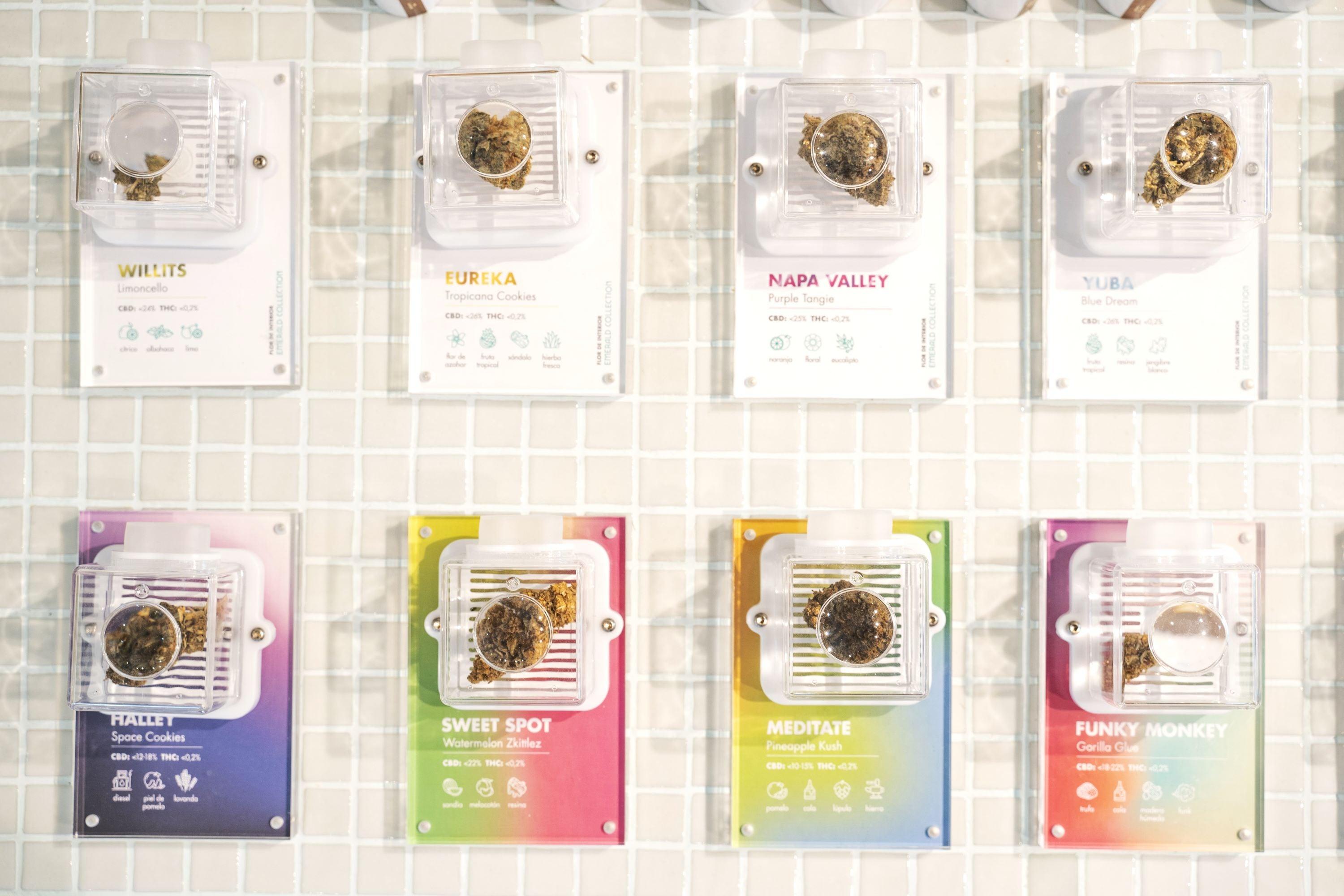
Cover photo: the display you can find in our CBD Barcelona and CBD Madrid shops.
In short – what does weed smell like?
- Cannabis smells of an earthy, herbal base, with notes that vary by strain: citrus, sweet, floral, piney or “skunk” (diesel).
- That smell comes from terpenes and sulphur compounds, not from CBD or THC, as cannabinoids have no smell.
- A stronger smell doesn’t mean more potency: judging the aroma of cannabis is as subjective as a wine tasting.
What does weed smell like?
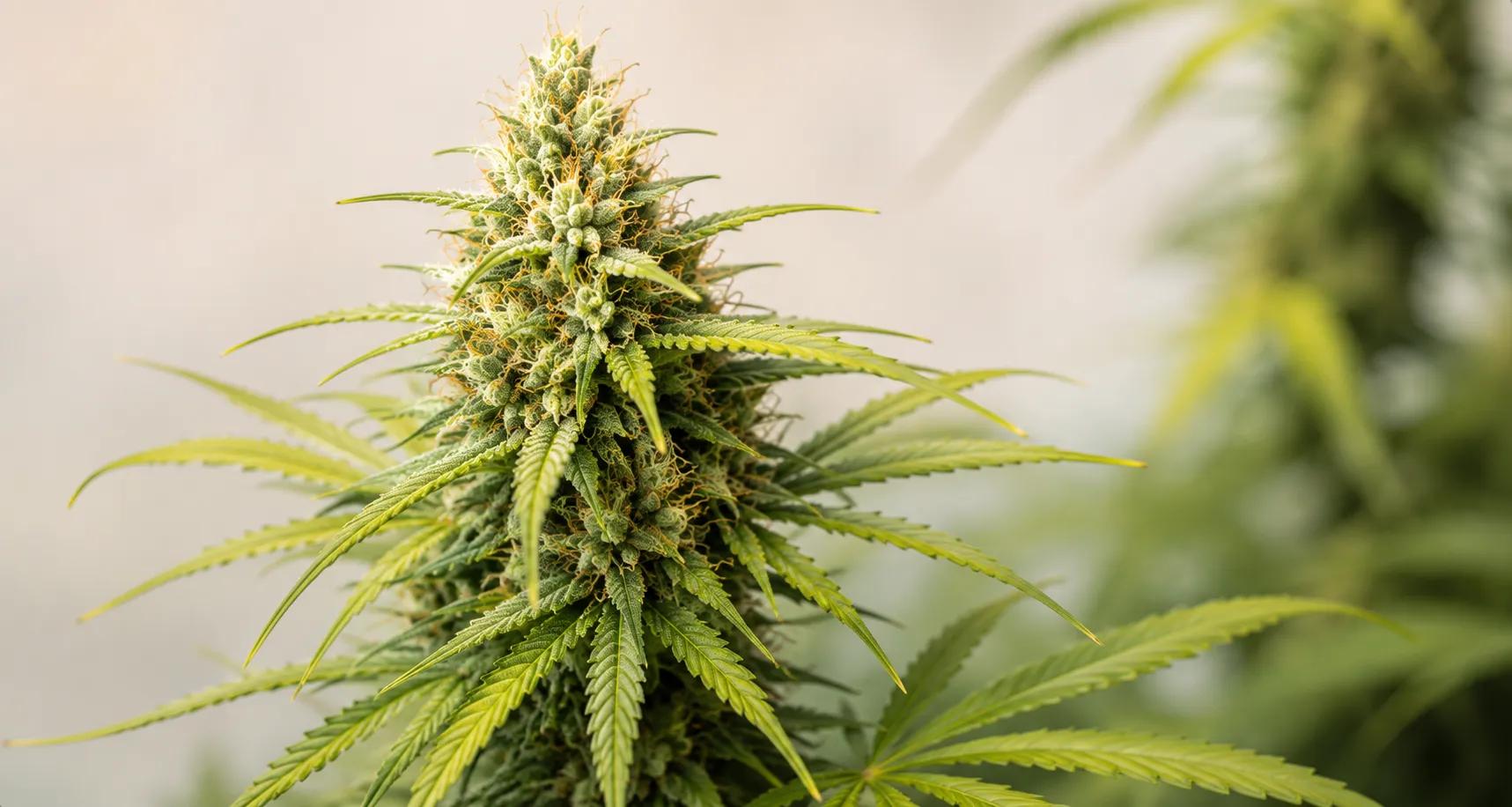
Cannabis has an unmistakable smell: an earthy, herbal and slightly spicy base, topped with very different notes depending on the strain: citrus, sweet, fruity, floral, piney or “skunk” (diesel). That aroma isn’t fixed: it depends on the plant’s genetics, how ripe it is and, above all, on the drying and curing of the bud.
What does weed smell like when it’s smoked?
When it burns, the smell becomes more intense, sweetish and slightly burnt. The characteristic “skunk” whiff gets stronger with combustion – largely because of the sulphur compounds in the resin – and clings to your clothes, your hair and the room for quite a while. That’s why the smell of smoked cannabis is far more pungent than that of the bud in your hand.
What does dried and cured weed smell like?
In a dry, well-cured bud the aroma is cleaner, more concentrated and more pleasant. Poor drying, on the other hand, leaves a smell of hay, damp or chlorophyll. In fact, a strong, well-defined smell is one of the signs of a good-quality bud, and it keeps better when you store it properly.
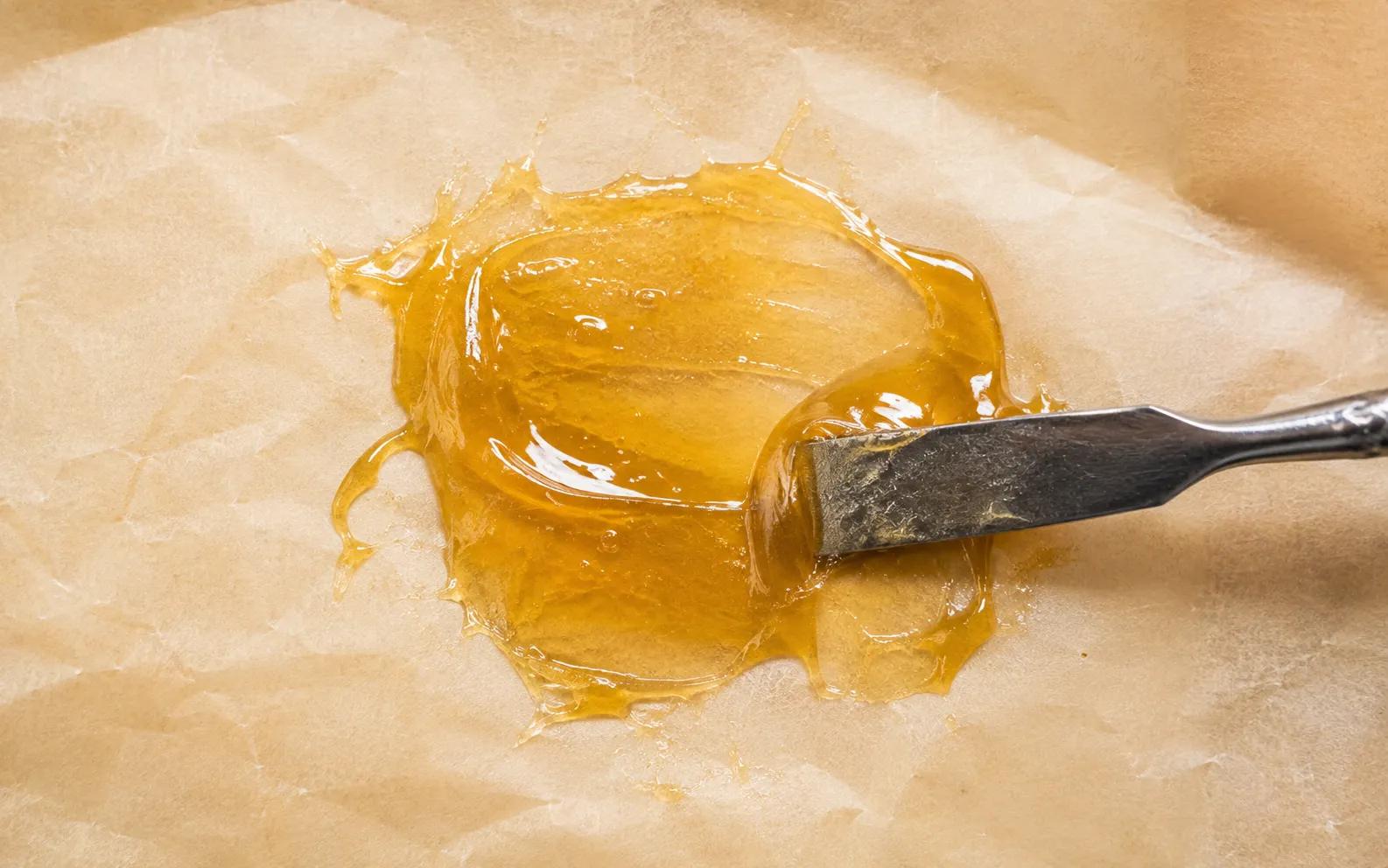
And what about derivatives such as hash? Because it concentrates the plant’s resin, its aroma is more intense, spicy and long-lasting than that of the flower; we explain it in depth in our hash guide.
What is the aroma of cannabis?
The aroma of cannabis is unmistakable and an essential part of the cannabis experience. As with wine or coffee, cannabis offers a wide range of aromas and nuances across its different strains. From citrus, sweet, floral or fruity aromas to earthy, spicy and diesel ones, the richness of cannabis is endless.
Cannabis tastings are becoming as popular as wine tastings.
Cannabis experts and connoisseurs are increasingly interested in appreciating the range of aromas that each cannabis strain has to offer. At Cannactiva, we classify the aromas of our CBD flower, and we can confirm that it’s often no easy task.
Terpenes: the compounds behind the smell of cannabis
The smell of cannabis is a complex symphony of chemical compounds, with terpenes playing the leading role. Terpenes are found inside the trichomes of cannabis, in the resin, together with the cannabinoids. Cannabinoids such as THC or CBD, however, have no smell at all.
Terpenes play the leading role in the aroma of cannabis, while cannabinoids such as THC or CBD have no smell at all.
Cannabis produces an extraordinary range of terpenes. It can produce the same terpenes found in citrus fruit (limonene), pepper (beta-caryophyllene), pine (alpha- and beta-pinene, terpinolene), lavender (linalool), mango (myrcene) or chamomile (bisabolol), to name a few. Its phytochemical richness is extraordinary.
Cannabis produces the same terpenes as a wide variety of other plants, such as pine, lemons, pepper, mango or lavender.
These compounds do far more than simply please our sense of smell: terpenes evoke a range of sensations and effects in cannabis users, and can affect mood. From sedation to lifting mood or improving memory, the properties of these compounds are unique.
Although terpenes play the leading role, they don’t act alone: volatile sulphur compounds are largely responsible for the characteristic “skunk” smell of many strains, especially when they’re smoked. They explain why two plants with similar terpenes can smell very different.
Alongside terpenes and sulphur, flavonoids add subtler nuances to each strain’s aroma and colour profile.

And beyond smell, terpenes also influence how we feel: find out about the effects of cannabis terpenes.
Another interesting aspect of terpenes is how they influence the effect of cannabis. We know these compounds are much more than aromas: they work in synergy with cannabinoids and modulate their effect, which is known as the cannabis entourage effect.
How are cannabis aromas classified?
Classifying cannabis aromas is more complex than it seems. While science gives us an idea of the compounds behind the aroma (mainly terpenes), human experience tells us something different.
Measuring terpenes
Following the terpene “boom”, those devoted to studying these aroma profiles proposed terpene analysis as a way to classify the different strains and cultivars by their terpene profile. In fact, after the legalisation of cannabis and the professionalisation of the sector in the United States, we have seen many dispensaries add terpene analysis to their product pages. But we now know that this method doesn’t hold up and can confuse more than it helps.
The “scent scientist” Dr Avery Gilbert, PhD, explains that terpene analysis is not enough to capture the essence of cannabis, because smells are so complex: molecules interact with one another to produce combinations that result in unique aromas.
Aroma charts: it’s not that simple!
You might think that identifying the most abundant terpenes in a strain would give us an exact description of its aroma, but the reality is far more complex.
Each terpene has a unique relationship between its concentration and the intensity of its aroma. What’s more, when they combine, they create aroma profiles that are more than the mere sum of their parts.

Listing terpenes in order of abundance in cannabis doesn’t tell us what something actually smells like. When terpenes are mixed, the result on the nose is different from the individual smells of each terpene. In fact, before creating a perfume, perfumers study not only the primary aromas but also their basic combinations (known as “accords”).

That unique combination of terpenes is also behind the differences between indica and sativa.
The mysteries behind the aroma of cannabis
Another important factor is the detection threshold of aromas. Each terpene has a minimum concentration from which its aroma can be perceived. The concentration detectable by the human nose is much lower than the level of terpenes a gas chromatograph can detect.
The human sense of smell can detect terpenes in tiny amounts that machines can’t pick up.
Moreover, each terpene has a unique relationship between its concentration and the intensity of its smell. Some terpenes have a much stronger smell than others at the same concentration. What’s more, small variations in concentration can lead to big variations in which smell dominates. This is why, Dr Gilbert explains, small changes to a perfume can make it seem very different to us.
All of this makes it extremely difficult to translate a chromatogram or terpene analysis into a specific cannabis aroma. We need subjective appreciation to really assess how cannabis smells!
Cannabis tastings
A subjective assessment or “smell test” is absolutely necessary to understand an aroma. Only through a cannabis tasting is it possible to uncover the unique aroma profiles of specific cannabis strains.
According to a scientific study (2) in which participants were asked to describe different cannabis strains by their aroma, it seems that cannabis aroma profiles can be grouped into two broad categories: earthy, woody and herbal aromas, or citrus, sweet and sharp or pungent aromas.
Interestingly, the study also found that strains with citrus aromas were perceived as more potent and therefore had a higher estimated price than strains with earthy aromas.
That said, cannabis tastings aren’t a foolproof method either. Perceiving an aroma isn’t just a sensory experience: it’s influenced by emotional, cultural and memory factors. Two people may describe the same aroma differently because of their own experiences, memories and references.
What’s more, people who use cannabis may perceive its aromas differently from those who don’t.
A great way to train your sense of smell is to smell and compare several strains at once: you can set up your own tasting with a CBD flower bundle of fresh citrus, sweet and tropical, earthy kush or floral skunk strains, grouped precisely by aroma family.
In conclusion…
Classifying cannabis aromas is a world of its own. Not only is there a huge wealth of aromatic compounds and possible combinations in cannabis, but there is also a dance between science and sensation that makes it hard to establish a “universal” classification. Yet, at the same time, this subjectivity is what lets us experience unique sensations with this plant.
We invite you to find your favourite strains with one of our bundles. Explore the variety of aromas that cannabis has to offer!
Browse our full range of CBD flower and find the aromas that suit you best.
References
- Avery Gilbert, Ph.D., Headspace Sensory, LLC. The Chemistry and Perception of Terpenes. Article in Terpenes & Testing Magazine, 2021. Available at: https://www.averygilbert.com/
- Gilbert AN, DiVerdi JA. Consumer perceptions of strain differences in Cannabis aroma. PLoS One. 2018 Feb 5;13(2):e0192247. doi: 10.1371/journal.pone.0192247. PMID: 29401526; PMCID: PMC5798829.