The unique aroma of your favourite CBD flower, as well as the different effects it can produce, is largely determined by terpenes. With cannabis being legalised in more and more countries, the cannabis industry has modernised. Today, customers look not only for potency in THC and CBD but also for specific terpene profiles, which has driven up demand for terpene analysis in laboratories. Here I'll tell you about some of the ways these terpenes are measured, plus a few more curiosities about these compounds.
Introduction to terpene analysis
What is terpene analysis?
Terpene analysis covers the methods used to quantify the amount of terpenes in a sample. This analysis is crucial for determining the sensory and therapeutic properties of plants, especially in the case of Cannabis sativa.
Since all these compounds may be acting in unison to produce a particular effect in cannabis, it is important to know which compounds are being consumed. That is why terpene analysis is an increasingly requested service in laboratories.
What are terpenes and how are they classified?
Terpenes are volatile organic compounds that contribute to the aroma and flavour of a great many plants [7], including the cannabis plant, and they form the basis of many essential oils used in food or in the production of cosmetics [8], for example.
Terpenes appear to have therapeutic properties, including anti-inflammatory, anticancer, antiseptic, astringent, analgesic, antidepressant, antimicrobial and digestive properties [1-6]. In particular, terpenes in the *Cannabis sativa *plant not only define the sensory properties of cannabis buds but may also influence their therapeutic properties [7].
Terpenes are derived from various combinations of isoprene units, an aromatic organic compound with five carbon atoms (C5). Terpenes are classified by their number of carbon atoms: monoterpenes have ten carbons (C10), sesquiterpenes have fifteen (C15) and diterpenes have twenty (C20) [7].
How does terpene analysis help with cannabis quality control?
A high-quality cannabis sample should have a diversity of terpenes. When the terpene aroma has been lost, the sample may be old or may not have been grown properly.
Terpenes in Cannabis sativa
Terpene diversity in Cannabis sativa
In the cannabis plant, terpenes are one of the greatest sources of phenotypic diversity, and around 150–200 different terpenes have been reported in cannabis, mostly monoterpenes and sesquiterpenes [8, 9].
Most common terpenes in Cannabis sativa
In drug-type *Cannabis sativa *available from dispensaries in the United States, the most common terpenes are beta-myrcene and limonene, both monoterpenes, and beta-caryophyllene, which is a sesquiterpene [10].
Why terpenes matter in cannabis
Because of their properties, terpenes contribute to the smoking experience, as they provide particular aroma profiles as well as possible effects on the body. These aromatic compounds can interact with cannabinoids and enhance their effects. They can also interact with other terpenes present in the plant. This phenomenon, known as the entourage effect, increases the therapeutic benefits of cannabis.
Some cannabis terpenes are associated with particular effects. The “sativa effect”, for example, is a popular term for strains that produce energising, uplifting effects. These could contain terpenes such as limonene and pinene, which have a fresh, citrusy aroma. “Indica effect” strains could contain more myrcene, a terpene with an earthy aroma that is associated with relaxing, calming effects. If you want to go deeper, read our post on the differences between indica and sativa.
Terpene analysis methods
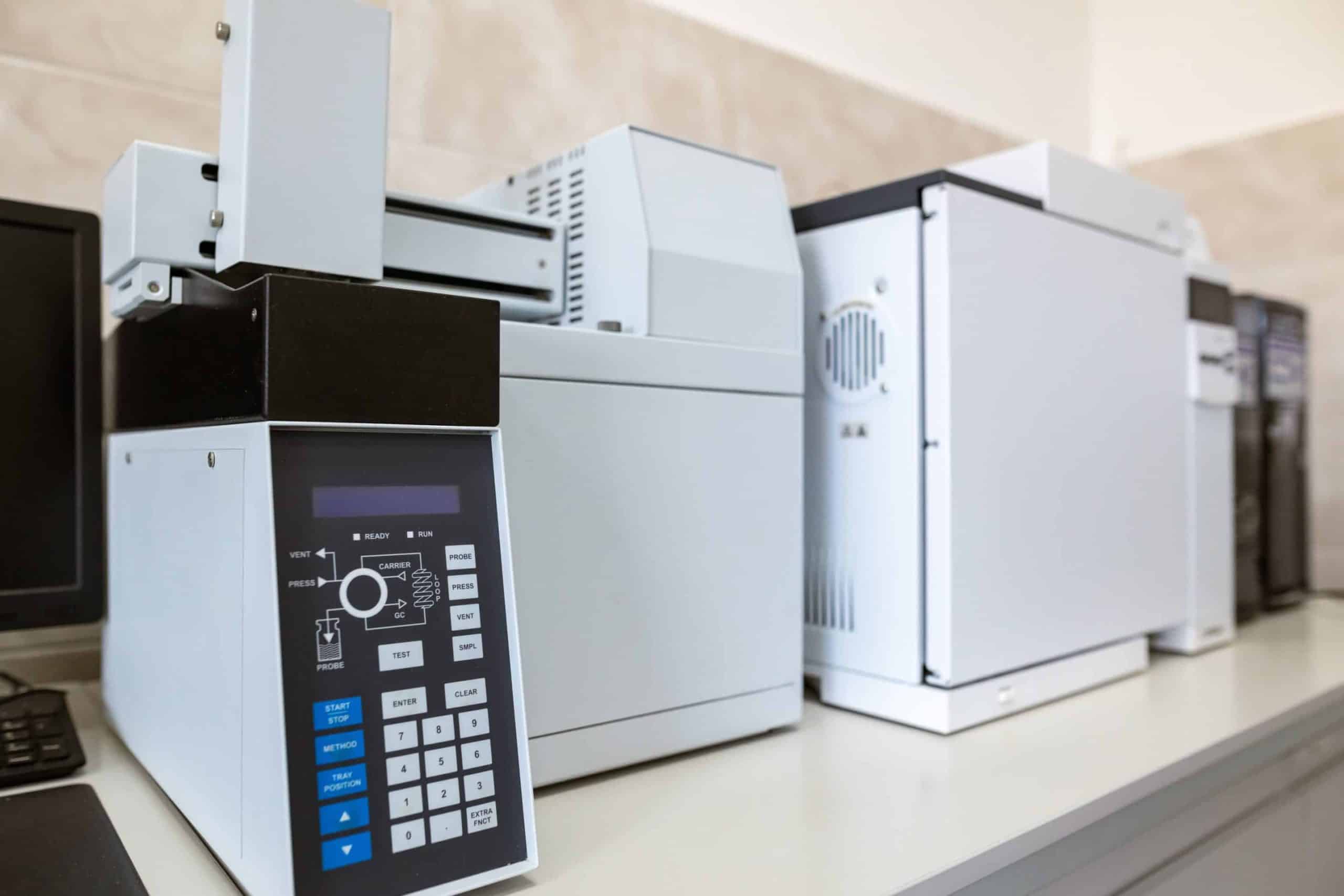
The most widely used method for measuring terpenes is gas chromatography, which can be combined with mass spectrometry to obtain more accurate results.
There are also the SPME and VASE techniques. Given how volatile terpenes are, gas chromatography is one of the most widely used techniques for determining them.
Gas chromatography: the most widely used method for measuring terpenes
Gas chromatography (GC) is the most widely used way of measuring terpenes. This technique is also used for cannabinoid analysis. It uses a gas as the mobile phase, and the sample has to be heated to homogenise it.

Combining gas chromatography and mass spectrometry (GC-MS)
Gas chromatography can be combined with mass spectrometry (MS), a technique that determines the weight of each compound. This combination, abbreviated as GC-MS, is fairly accurate for measuring both cannabinoids and terpenes.
In this process, after the terpenes have been separated by GC, they are fragmented and analysed by MS according to their mass-to-charge ratio. This provides additional information that can help confirm the identity of the terpenes in the sample.
In this way, the terpenes in a cannabis sample can be identified and quantified fairly accurately, which can be very useful for producers and consumers who want to understand and control the terpene profile of their products.
Alternatives to gas chromatography: HS-SPME and VASE
Other techniques are also used to measure terpenes. One of them is headspace solid-phase microextraction (HS-SPME), a method that does not require solvents. The headspace is the layer of gas above a sample in a vial, and this is what is analysed rather than the volume below it where the sample sits.
HS-SPME is therefore used on volatile samples, such as those containing benzene, toluene and xylenes [8]. One advantage of HS-SPME is that sampling, extraction and concentration measurement can be done in a single step [7].
Because terpenes are volatile, some of the techniques for measuring them do not use solvents, or they measure the empty space instead of the compound.
Vacuum-assisted sorbent extraction (VASE) is based on the use of a sorbent in the headspace that has been exposed to the plant’s inflorescence for a set time.
This inflorescence is heated to 100°C at a pressure of 0.36 atm. Several techniques analyse the headspace, but VASE ensures an exhaustive extraction thanks to the large amount of sorbent material [7].
Important considerations in terpene evaluation
It is important to standardise the methods for assessing the composition of *Cannabis sativa *inflorescences and the extraction protocols. A good understanding of these protocols and methods is crucial, since those that pre-heat the flower can degrade or evaporate the terpenes before they are analysed, altering the result [7].
Because terpenes are volatile, when the flower is heated to decarboxylate the cannabinoids, the terpenes degrade or evaporate.
Trying to decarboxylate the cannabinoids creates a problem, since heating alters the terpene profile [7]. That is why pre-heating is not recommended, so that products high in terpenes can be obtained [7, 11].
Extracting cannabis terpenes at home
One solvent for extracting terpenes that seems to work very well is olive oil, as it dissolves the terpenes while preventing them from evaporating.
* You may also be interested in: Homemade cannabis extractions
Mysteries and curiosities of terpenes in Cannabis sativa
Well, last time I left you with an open question, and we now have a little more information about it. The ecological reason why the *Cannabis sativa *plant produces all these compounds is still unclear, but terpenes appear to be a defence mechanism [12, 13]. So, if the plant is grown in places where it needs protection, it would produce more of these compounds. A recent study suggests that when the plant is grown outdoors, it produces more terpenes than when it is grown indoors [14]. These preliminary results indicate that the phenotypic expression of these terpenes in Cannabis sativa seems to depend heavily on the environment, and it can differ between two plants of the same strain grown under different environmental conditions [14].
Well, I hope I get to try some of your terpene-rich olive oil extractions. Let me know how you get on!
References
- Cox-Georgian, D., et al., Therapeutic and medicinal uses of terpenes, in Medicinal Plants. 2019, Springer. p. 333-359.
- Kamatou, G.P. and A.M. Viljoen, Linalool–A review of a biologically active compound of commercial importance. Natural product communications, 2008. 3(7): p. 1934578X0800300727.
- Rogerio, A.P., et al., Preventive and therapeutic anti‐inflammatory properties of the sesquiterpene α‐humulene in experimental airways allergic inflammation. British Journal of Pharmacology, 2009. 158(4): p. 1074-1087.
- Chaves, J.S., et al., Pharmacokinetics and tissue distribution of the sesquiterpene α-humulene in mice. Planta medica, 2008. 74(14): p. 1678-1683.
- dos Santos, É.R., et al., Linalool as a Therapeutic and Medicinal Tool in Depression Treatment: A Review. Current Neuropharmacology, 2022. 20(6): p. 1073-1092.
- Salehi, B., et al., Therapeutic potential of α-and β-pinene: A miracle gift of nature. Biomolecules, 2019. 9(11): p. 738.
- Micalizzi, G., et al., Cannabis Sativa L.: A comprehensive review on the analytical methodologies for cannabinoids and terpenes characterization. Journal of Chromatography A, 2021. 1637: p. 461864.
- Bakro, F., et al., Simultaneous determination of terpenes and cannabidiol in hemp (Cannabis sativa L.) by fast gas chromatography with flame ionization detection. Journal of Separation Science, 2020. 43(14): p. 2817-2826.
- Radwan, M.M., et al., Cannabinoids, phenolics, terpenes and alkaloids of cannabis. Molecules, 2021. 26(9): p. 2774.
- Smith, C.J., et al., The Phytochemical Diversity of Commercial Cannabis in the United States. bioRxiv, 2021.
- Romano, L.L. and A. Hazekamp, Cannabis oil: chemical evaluation of an upcoming cannabis-based medicine. Cannabinoids, 2013. 1(1): p. 1-11.
- Vergara, D., et al., Genetic and Genomic Tools for Cannabis sativa. Critical Reviews in Plant Sciences, 2016. 35(5-6): p. 364-377.
- Kovalchuk, I., et al., The Genomics of Cannabis and Its Close Relatives. Annual Review of Plant Biology, 2020. 71.
- Zandkarimi, F., et al., Comparison of the Cannabinoid and Terpene Profiles in Commercial Cannabis from Natural and Artificial Cultivation. Molecules, 2023. 28(2): p. 833.