Hemp vs marijuana: differences, similarities and uses
Hemp and marijuana are the same botanical species, Cannabis sativa L., but they are not the same plant: they differ in their genetics, in how much THC and CBD they produce, in their appearance, in how they are grown, in their uses and in their legal status. In short, hemp is grown for its fibre, its grain and its CBD (with THC ≤ 0.3%, it doesn't get you high), while marijuana is grown for its flowers, which are rich in THC (the psychoactive cannabinoid).
In this article, Cannabis geneticist Dr Daniela Vergara explains exactly what separates hemp from marijuana – and why CBD flower is a case apart. If you'd like to see the full map of the different cannabis strains first, start there.
In short:
- Same species, different use: hemp and marijuana are Cannabis sativa L.; what changes is what each plant is grown for (raw materials, THC or CBD).
- THC is the legal key: hemp ≤ 0.3% THC (non-psychoactive); marijuana, up to 30%.
- CBD flower is, genetically, low-THC, CBD-rich marijuana: neither classic industrial hemp nor psychoactive marijuana.
Hemp vs marijuana: differences and similarities at a glance
Trait | Industrial hemp | Marijuana | CBD cannabis |
|---|---|---|---|
Species | Cannabis sativa L. | Cannabis sativa L. | Cannabis sativa L. |
THC | ≤ 0.3% | 5–30% | ≤ 0.3% |
CBD | Low / variable | Variable | High |
Grown for | Fibre, grain, CBD | THC-rich flower | CBD-rich flower |
Effect | Non-psychoactive | Psychoactive | Non-psychoactive |
Plant | Tall, sparsely branched | Short, branched, buds | Like marijuana |
Cultivation | Extensive (maize-like) | Horticultural (tomato-like) | Horticultural |
Legal in Spain | Yes (≤ 0.3% THC) | No (with some exceptions) | Yes (≤ 0.3% THC) |

Are hemp and marijuana the same plant? (Cannabis sativa L.)
Hemp and marijuana come from the same plant, Cannabis sativa L., but they are very different from each other. Sharing a scientific name does not mean they are identical: that name only indicates their botanical classification – that they share the same basic structure (what their flowers and seeds are like, the shape of their leaves…) – not that they are the same variety or that they are used for the same things. What separates them is centuries of human selection for very different purposes: some varieties have been grown for their raw materials (fibre and grain) and others for their flowers and the cannabinoids they produce.
There are many similar examples in the plant world. Broccoli, cauliflower, cabbage, red cabbage, spring greens and Brussels sprouts are all the same species, Brassica oleracea, and yet they look nothing alike: different colour, shape, flavour and use in the kitchen. Nobody would say that a purple red cabbage and a green broccoli are “the same vegetable”, even though botanically they are.
It's exactly the same with cannabis. Just as red cabbage expresses a purple colour and broccoli a green one, within Cannabis sativa some plants express a lot of THC – marijuana, with its psychoactive effect – and others a lot of CBD and barely any THC – hemp and CBD flower. Same species; different genetic “recipes”.
Similarities between hemp and marijuana
Cannabis sativa is a flowering plant (angiosperm). Together with its closest relative, Humulus sp. (the hops used in beer), it belongs to the Cannabaceae family. Both share a curious trait: they are dioecious plants, that is, with separate male and female individuals (you can see how to tell male and female cannabis plants apart). Only around 6% of angiosperms are dioecious; most are monoecious or hermaphrodite [1-3].
The genus Cannabis has a single species, Cannabis sativa L. The word “sativa” comes from the Latin for “cultivated”, and the species was described by Carolus Linnaeus in 1753 [4], based on the plants grown in Europe for fibre and grain: in other words, hemp. Years later, in 1785, Jean-Baptiste Lamarck described as Cannabis indica some specimens from India with a different phenotype, used to produce cannabinoids: in practice, marijuana. That historical distinction shows how the use the plant was put to ended up shaping its differences. (Today, moreover, the commercial terms sativa and indica have little biological backing.)

What is the difference between hemp and marijuana?
Although we recognise a single species, Cannabis sativa has enormous variation both phenotypic (physical) and genotypic (in its DNA). Within the species there are several lineages: the individuals used for fibre or grain share more DNA with each other than with those grown to produce cannabinoids for medical or recreational purposes.
Genetic differences between hemp and marijuana
Hemp plants intended for stalk (fibre) or seed (grain) are genetically closer to each other. By contrast, Cannabis sativa plants grown to obtain cannabinoids – marijuana (THC) and CBD cannabis – resemble each other more and are further from fibre or grain hemp. There are high-CBD hybrids between marijuana and industrial hemp (such as the Otto II variety) [5], and, in any case, they can all cross with one another because they are the same species. An important nuance: although CBD flower is usually lumped in with “industrial hemp”, genetically it tends to be closer to marijuana.
Does industrial hemp produce cannabinoids (CBD and THC)?
Yes: hemp plants also produce cannabinoids, but in smaller amounts, and they are not grown for that purpose but for fibre or grain. There is fibre hemp (varieties such as Fibranova, Finola or Carmagnola, known for their stalks, which also yield the hurds used in building materials such as hempcrete – one of the many uses of industrial hemp) and grain hemp (such as USO31, whose seed yields food-grade hemp oil), as well as dual-purpose varieties.
Hemp strains versus marijuana strains
Hemp varieties have a long agricultural history and names tied to their use. Marijuana strains, on the other hand, carry commercial and colloquial names – Punto Rojo, Jack Herer… – with hardly any biological meaning.

Physical differences between hemp, marijuana and CBD cannabis
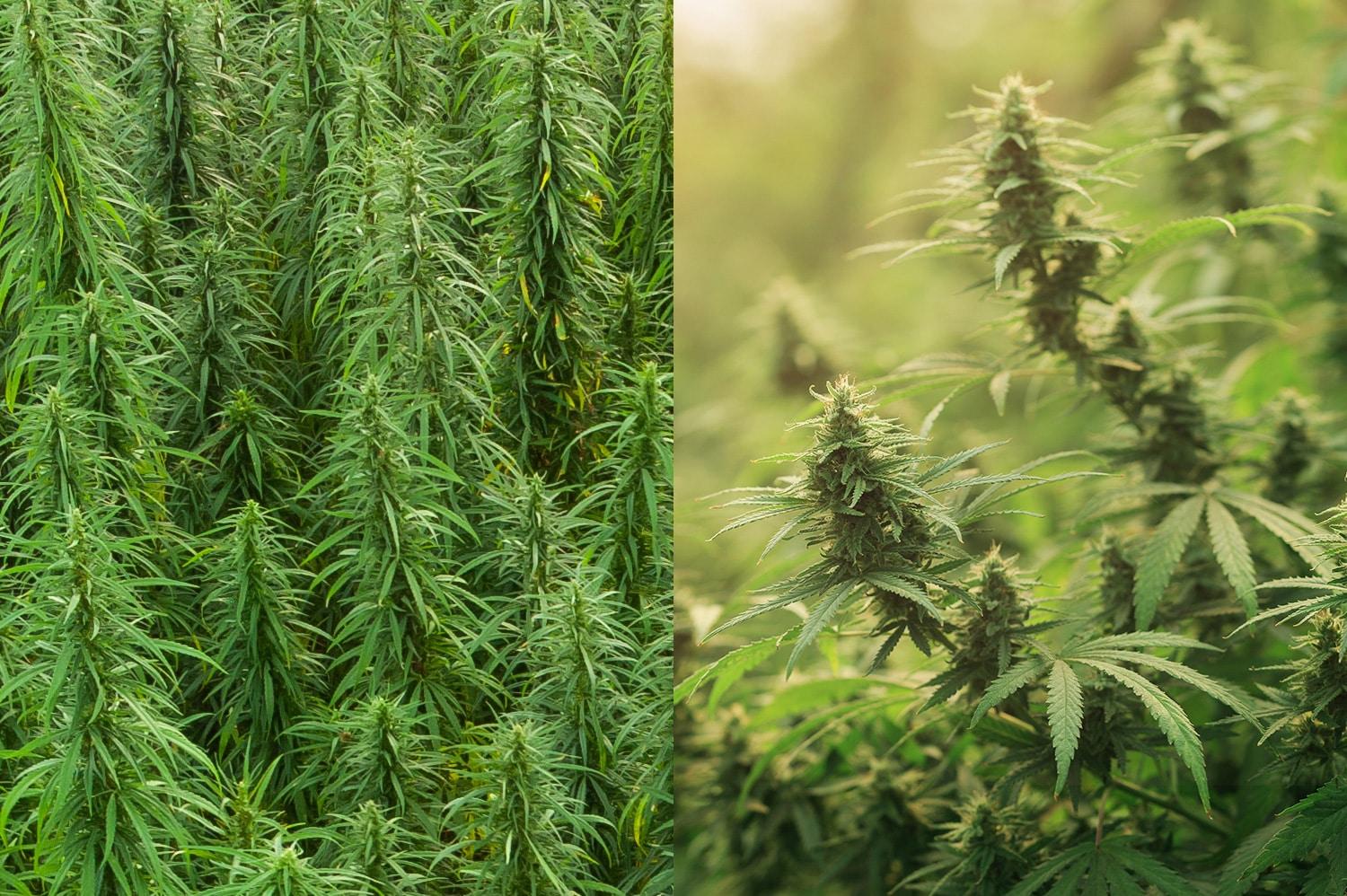
There are physical traits (phenotypes) shared by marijuana and CBD cannabis, and others unique to industrial hemp. Fibre or grain hemp is tall (4–6 m), thin and sparsely branched. Marijuana, by contrast, is shorter, heavily branched, with thick stalks and large inflorescences (buds) on the female plant. Although the plant produces hundreds of compounds (cannabinoids, terpenes, flavonoids), the industry usually divides it according to the two best-known cannabinoids: THC and CBD.
Cannabinoids in hemp and marijuana: THC and CBD
Cannabinoids are compounds of Cannabis sativa that interact with our endocannabinoid system and have psychoactive or other properties [6-11]. The plant produces hundreds of compounds; the best known are the cannabinoids and the terpenes (responsible for the aroma, which also interact with the endocannabinoid system) [12-15]. You can see all the types of cannabinoids and their effects. The two main players are THC, responsible for marijuana's psychoactive effect, and CBD, which is non-psychoactive; we go through all the differences between CBD and THC in our guide.
Our endocannabinoid system is another of the systems in the human body, just like the digestive or cardiovascular system. This system is responsible for regulating some of our activities, such as hunger, sleep or pain [16-20]. Our body, therefore, also produces cannabinoids, called endocannabinoids, such as anandamide.
Phytocannabinoids are cannabinoids that are not endocannabinoids and are produced by plants. Other plants also produce cannabinoids, but C. sativa produces several of them, and THCA is the best known.
The difference between THC and THCA
In the living plant, the cannabinoid is not present as THC but as THCA (its acidic form), which is not psychoactive. Only when heated (by smoking or vaporising) does THCA lose a carboxyl group – a process called decarboxylation – and turn into active THC. That is why the content is usually expressed as “THC/A”.
Like THCA, the plant produces cannabidiolic acid, CBDA, which, when heated, turns into the neutral form CBD, cannabidiol. CBD is not psychoactive, but it is psychotropic. That is, it does have effects on our brain, but it is not as inebriating or intoxicating as THC. CBD has considerable medical potential [21-24], although a great deal of research is still needed on it and on all the compounds the plant produces.
Is CBD flower hemp or marijuana?
The plants grown to obtain CBD flower are, in practice, low-THC, CBD-rich marijuana: what sets them apart is their chemotype. There are chemotypes high in THC and low in CBD, others rich in CBD and poor in THC, and others that are balanced [25]. In other words, CBD cannabis is genetically and physically closer to marijuana than to fibre or grain hemp, even though legally it falls under the hemp limit (≤ 0.3% THC). If you're looking for quality, we cover it in best CBD buds.
Can you smoke hemp? Effects of CBD hemp
It depends on which “hemp”. Industrial hemp grown for fibre or grain is not smoked: it goes into textiles, paper, construction or food. What can be smoked or vaporised is CBD-rich hemp flower (what we call CBD flower). With THC ≤ 0.3%, it does not produce a “high” or any psychoactive effect: that is precisely the difference from marijuana. To understand what CBD is and why it doesn't alter the mind the way THC does, you can read about the effects of marijuana on the brain.
Warning: CBD products are not medicines and have no therapeutic purpose, and are for adults over 18 only.
Differences in growing hemp and marijuana
Fibre or grain hemp is sown very densely and on a large scale, like maize, wheat or sorghum, and is harvested with large machinery (threshers, balers). Marijuana is grown on a smaller scale and in a horticultural way, like tomatoes or peppers, with a lot of manual labour in harvesting, drying and processing. Moreover, the goals are opposite: in grain hemp seeds are sought; in marijuana pollination is avoided to obtain seedless buds.
Processing hemp, especially for textile fibre, is quite expensive: it requires specialised factories and large-scale crops (many hectares) to supply them.
So what happens if these hemp and marijuana plants end up crossing? For example, if they are grown outdoors and pollen is transferred between hemp and marijuana plants. Could this pollen transfer be prevented? Although I think preventing pollination will be difficult, it might be possible to prevent the fertilisation of the flower through genetic modification, but that is a subject for another article.
Legal differences between hemp and marijuana in Spain
The legal boundary is set by THC. In the European Union and in Spain, hemp is legal as long as its THC content is ≤ 0.3% and it comes from certified hemp seeds listed in the Common Catalogue; marijuana (with more THC) falls outside that framework, except in regulated cases. The Court of Justice of the EU made clear in the Kanavape case that CBD is not a narcotic and can move freely within the EU. Marijuana plants reach 17–35% THC/A [26] – in fact, its potency has gone from 4% to 35% THC in a few decades – while industrial hemp rarely exceeds 9% total cannabinoids [26], although it sometimes goes over 0.3% THC and causes problems for growers. We go into more detail on CBD and hemp legality in Spain.
These legal definitions of hemp can be hard to comply with, because the enzymes (proteins) that produce these compounds in the plant are both promiscuous and sloppy [28, 29], but that is also another story.
Well, I hope you have enjoyed this piece and learned something about hemp, marijuana and the Cannabis sativa plant in general. I hope to tell you another interesting story about this plant another time.
Hemp or marijuana: frequently asked questions
Is hemp the same as marijuana?
No. They are the same species (Cannabis sativa L.), but hemp is grown for its fibre, grain and CBD, with THC ≤ 0.3% that does not get you high; marijuana is grown for its THC-rich flowers.
Is cannabis the same as marijuana?
“Cannabis” is the name of the genus (and of the species, Cannabis sativa). “Marijuana” is only the THC-rich cannabis used for its flowers. Everything is cannabis; not all cannabis is marijuana.
Can you smoke hemp and what effects does it have?
Industrial hemp is not smoked. CBD-rich hemp flowers can be, but they are not psychoactive: they do not cause marijuana's effect.
What is “hemp” in a joint?
Colloquially, the CBD flower used for rolling (on its own or as a tobacco substitute) is sometimes called “hemp” precisely because it does not get you high.
At Cannactiva we work with CBD flower from quality hemp, lab tested and with THC within the legal limit.
References
- Charlesworth, D., Plant sex determination and sex chromosomes. Heredity, 2002. 88(2): p. 94-101.
- Charlesworth, D., Plant sex chromosome evolution. Journal of experimental botany, 2013. 64(2): p. 405-420.
- Charlesworth, D., B. Charlesworth, and G. Marais, Steps in the evolution of heteromorphic sex chromosomes. Heredity, 2005. 95(2): p. 118-128.
- Watts, G., Science commentary: Cannabis confusions. BMJ: British Medical Journal, 2006. 332(7534): p. 175.
- Lynch, R.C., Vergara, D., Tittes, S., White, K., Schwartz, C.J., Gibbs, M.J., Ruthenburg, T.C., DeCesare, K., Land, D.P. and Kane, N.C. Genomic and Chemical Diversity in Cannabis. Critical Reviews in Plant Sciences. 2016. 35: 349–363.
- Russo, E.B., Taming THC: potential cannabis synergy and phytocannabinoid-terpenoid entourage effects. British Journal of Pharmacology, 2011. 163(7): p. 1344-1364.
- Swift, W., et al., Analysis of cannabis seizures in NSW, Australia: cannabis potency and cannabinoid profile. PloS one, 2013. 8(7): p. e70052.
- Volkow, N.D., et al., Adverse Health Effects of Marijuana Use. New England Journal of Medicine, 2014. 370(23): p. 2219-2227.
- ElSohly, M.A., et al., Potency Trends of delta 9-THC and Other Cannabinoids in Confiscated Marijuana from 1980-1997. Journal of Forensic Sciences, 2000. 45(1): p. 24-30.
- ElSohly, M.A. and D. Slade, Chemical constituents of marijuana: the complex mixture of natural cannabinoids. Life sciences, 2005. 78(5): p. 539-548.
- Russo, E.B. and J.M. McPartland, Cannabis is more than simply Δ9-tetrahydrocannabinol. Psychopharmacology, 2003. 165(4): p. 431-432.
- Ferber, S.G., et al., The “entourage effect”: terpenes coupled with cannabinoids for the treatment of mood disorders and anxiety disorders. Current neuropharmacology, 2020. 18(2): p. 87-96.
- Janero, D.R. and A. Makriyannis, Terpenes and lipids of the endocannabinoid and transient-receptor-potential-channel biosignaling systems. ACS chemical neuroscience, 2014. 5(11): p. 1097-1106.
- Cox-Georgian, D., et al., Therapeutic and medicinal uses of terpenes, in Medicinal Plants*. *2019, Springer. p. 333-359.
- Booth, J.K. and J. Bohlmann, Terpenes in Cannabis sativa–From plant genome to humans. Plant Science, 2019. 284: p. 67-72.
- Berry, E.M. and R. Mechoulam, Tetrahydrocannabinol and endocannabinoids in feeding and appetite. Pharmacology & therapeutics, 2002. 95(2): p. 185-190.
- McPartland, J.M., et al., Evolutionary origins of the endocannabinoid system. Gene, 2006. 370: p. 64-74.
- Mechoulam, R. and L.A. Parker, The endocannabinoid system and the brain. Annual review of psychology, 2013. 64: p. 21-47.
- Salzet, M., et al., Comparative biology of the endocannabinoid system. European Journal of Biochemistry, 2000. 267(16): p. 4917-4927.
- Zogopoulos, P., et al., The role of endocannabinoids in pain modulation. Fundamental & clinical pharmacology, 2013. 27(1): p. 64-80.
- Leinow, L. and J. Birnbaum, CBD: A Patient's Guide to Medicinal Cannabis. 2017: North Atlantic Books.
- Rock, E.M., et al., Evaluation of the potential of the phytocannabinoids, cannabidivarin (CBDV) and Δ9‐tetrahydrocannabivarin (THCV), to produce CB1 receptor inverse agonism symptoms of nausea in rats. British journal of pharmacology, 2013. 170(3): p. 671-678.
- Tzadok, M., et al., CBD-enriched medical cannabis for intractable pediatric epilepsy: The current Israeli experience. Seizure, 2016. 35: p. 41-44.
- Zuardi, A.W., J.E.C. Hallak, and J.A.S. Crippa, Interaction between cannabidiol (CBD) and∆ 9-tetrahydrocannabinol (THC): influence of administration interval and dose ratio between the cannabinoids. Psychopharmacology, 2012. 219(1): p. 247-249.
- Jin D, Henry P, Shan J, Chen J. Identification of Chemotypic Markers in Three Chemotype Categories of Cannabis Using Secondary Metabolites Profiled in Inflorescences, Leaves, Stem Bark, and Roots. Front Plant Sci. 2021 Jul 1;12:699530.
- Smith, C.J., et al., The Phytochemical Diversity of Commercial Cannabis in the United States. bioRxiv, 2021.
- Schafroth MA, Mazzoccanti G, Reynoso-Moreno I, Erni R, Pollastro F, Caprioglio D, Botta B, Allegrone G, Grassi G, Chicca A, Gasparrini F, Gertsch J, Carreira EM, Appendino G. Δ9-cis-Tetrahydrocannabinol: Natural Occurrence, Chirality, and Pharmacology. J Nat Prod. 2021 Sep 24;84(9):2502-2510.
- Vergara, D., et al., Modeling cannabinoids from a large-scale sample of Cannabis sativa chemotypes. PloS one, 2020. 15(9): p. e0236878.
- Vergara, D., et al., Gene copy number is associated with phytochemistry in Cannabis sativa. AoB PLANTS, 2019. 11(6): p. plz074.
- Ahmed, A.F., et al., Hemp as a potential raw material toward a sustainable world: A review. Heliyon, 2022: p. e08753.