Cannabinoid receptors: key to understanding the effects of cannabis

Cannabinoid receptors are cell membrane proteins that cannabinoids bind to in order to activate the endocannabinoid system, the network that keeps the body's internal balance (homeostasis). There are two main types —CB1 and CB2— and they determine whether CBD, THC and the cannabinoids our own body produces have any effect. CB1 is one of the most abundant receptors in the brain.
What are cannabinoid receptors?
Cannabinoid receptors are components of the cell wall that interact with cannabinoids. These receptors are involved in signal transmission and play a crucial role in the effects and therapeutic properties of cannabinoids, including cannabidiol or CBD and tetrahydrocannabinol or THC. By binding to cannabinoid receptors, cannabinoids can modulate various physiological and biochemical functions in the human body.
These receptors are part of the endocannabinoid system, along with the cannabinoids and the cannabinoid enzymes.
You may never have heard of cell receptors, or perhaps they ring a faint bell from your secondary-school biology lessons. However, understanding cannabinoid receptors is essential to make sense of certain news about hemp and cannabis pharmacology. Below, we explain what they are, how they work and what effects the different types of cannabinoid receptors have.
Definition of cannabinoid receptors
Cannabinoid receptors are cell membrane proteins that cannabinoids bind to. Their function is to activate the endocannabinoid system and produce all its effects.
From a biochemical standpoint, CB1 and CB2 receptors are G protein-coupled receptors (GPCR), the largest family of cell receptors and the target of a great many drugs. This helps explain why the endocannabinoid system influences so many processes in the body.
Without cannabinoid receptors, neither CBD, nor THC, nor any other cannabinoid would have effects in the body. They are therefore an essential part of the endocannabinoid system.
This system plays an essential role in numerous physiological processes, such as the modulation of neurotransmitter release, the regulation of pain perception and cardiovascular function. Cannabinoid receptors are fundamental to how this system works.
Functions of cannabinoid receptors
Cannabinoid receptors have a specific structure that allows them to bind to cannabinoids. You can picture them as locks in the cell membranes that can only be opened with the right “keys”, which are the endocannabinoids produced by the body.
The main endocannabinoids —the “keys” our own body makes— are anandamide (AEA) and 2-AG (2-arachidonoylglycerol). They are the molecules these receptors are naturally designed for.
It has also been discovered that the cannabinoids in cannabis act as keys, activating these cannabinoid receptors. When cannabinoid receptors are activated, various changes occur in our body that give rise to the many effects of cannabinoids.
Through these receptors, the endocannabinoid system helps regulate numerous body functions, including:
- Pain and inflammation
- Appetite and digestion
- Sleep and rest
- Mood and the stress response
- Memory and learning
- The immune system response
- Cardiovascular function
Importance of cannabinoid receptors
Cannabinoid receptors are of great importance in research into the effects of cannabinoids. Depending on which type of receptor is activated, cannabinoids will have different effects. This is what marks the difference between a cannabinoid like THC and one like CBD. Although both are psychoactive and affect the central nervous system, only THC has significant psychoactive effects, whereas CBD does not get you high.
Furthermore, more and more substances are being discovered that modify the effects of cannabinoids by acting on the cannabinoid receptors. These substances can enhance or block the effects of cannabinoids. For example, there is talk of the synergies between terpenes and cannabinoids —the so-called entourage effect— in full spectrum CBD oil. Another interesting example is how CBD reduces the toxicity of THC (1).
In other words, cannabinoids do not act alone: their effects are the result of a complex interaction between cannabinoid receptors, enzymes and the cannabinoids themselves. Cannabinoid receptors, both CB1 and CB2, play an important role in the body and are responsible for the different effects of cannabinoids. This is the fascinating world of cannabinoid receptors and everything it entails for the endocannabinoid system!
Types of cannabinoid receptors
There are two main types of cannabinoid receptors: CB1 and CB2. The complexity of the topic of cannabinoid receptors lies in the fact that each type of receptor is distributed differently throughout the body, and each one is responsible for different functions (2).
CB1 | CB2 | |
|---|---|---|
Location | Brain and nervous system | Immune system and peripheral tissues |
In the brain | Very abundant | Almost absent |
Key effects | Psychoactivity, memory, pain, appetite | Anti-inflammation, immunity, pain |
THC target | Yes (agonist) | Weak |
CB1 cannabinoid receptors
The CB1 cannabinoid receptors are found mainly in the brain and are closely linked to the psychoactive effects of THC.
CB1-type cannabinoid receptors are distributed mainly in the brain, but also in many other parts of the body.
They are found across various brain regions (such as the hippocampus, the basal ganglia, the cortex, the cerebellum and other regions of both the telencephalon and the diencephalon), and they are also present in other organs and tissues of the body such as adipocytes (fat cells), the liver, the lungs, the smooth muscle tissue of the digestive tract, the pancreatic beta cells (responsible for insulin release and blood-glucose regulation), the vascular endothelium (which lines our arteries and veins), as well as the reproductive organs, the immune system and the peripheral sensory nerves and sympathetic nerves in other parts of the body.
CB1 cannabinoid receptors appear to be involved in biological activities related to the cardiovascular and gastrointestinal systems and the liver. Specifically, in the liver, they influence de novo lipogenesis (3). They also appear to play an important role in pain sensation, olfactory memory and the stress response (4, 5, 6). These receptors are also responsible for the euphoric and anticonvulsant effects of cannabis.
The presence of CB1 cannabinoid receptors in the cardiovascular system would explain one of the best-known side effects produced by THC: fainting (syncope). Fainting is a brief loss of consciousness that occurs when blood flow to the brain drops, and it can be triggered by smoking a lot of cannabis, as THC exerts a sedative effect on the walls of the blood vessels (which have many CB1 receptors).
The digestive system contains CB1 and CB2 cannabinoid receptors, which would explain the use of medical cannabis in cases of anorexia.
On the other hand, the presence of CB1 and CB2 cannabinoid receptors in the digestive organs, which regulate nutrient absorption and energy balance, explains some of the therapeutic effects of cannabinoids. THC is widely recognised in medicine for inducing an increase in appetite and is therefore used in treatments to combat anorexia and debilitating diseases such as HIV and cancer.
CB2 cannabinoid receptors
On the other hand, CB2 cannabinoid receptors are located mainly in the immune system and in peripheral tissues, including the endocannabinoid system of the skin. These receptors are associated with anti-inflammatory properties and may play a role in pain relief and in modulating the immune response.
CB2 receptors are found in peripheral tissues, above all in the immune system, and have been shown to have a strong capacity to modulate the response of defensive cells.
Specifically, CB2 receptors are present in the cells of the bone marrow, thymus, spleen, tonsils, T and B lymphocytes, monocytes, NK cells, PMNs and mast cells; all of them fundamental parts of the immune system. Stimulation of CB2 receptors has been associated above all with pain relief and anti-inflammatory effects.
71% of CB2 cannabinoid receptors have been located in the lymph nodes.
Unlike CB1, CB2 receptors are almost absent in the central nervous system (CNS). Although CB2 has been detected in the glial cells and astrocytes of the brain, its presence in neurons is not clear. Recent research suggests that the CB2 cannabinoid receptor may modulate emotions and be linked to schizophrenia, anxiety, depression and memory.
CBD and cannabinoid receptors
As for CBD, although it barely binds directly to the CB1 or CB2 cannabinoid receptors, it has been found that it can modulate the activity of these receptors and of other related receptors. This partly explains why CBD can have diverse therapeutic effects and how it can influence the body's response to cannabinoids.
How substances can interact with cannabinoid receptors
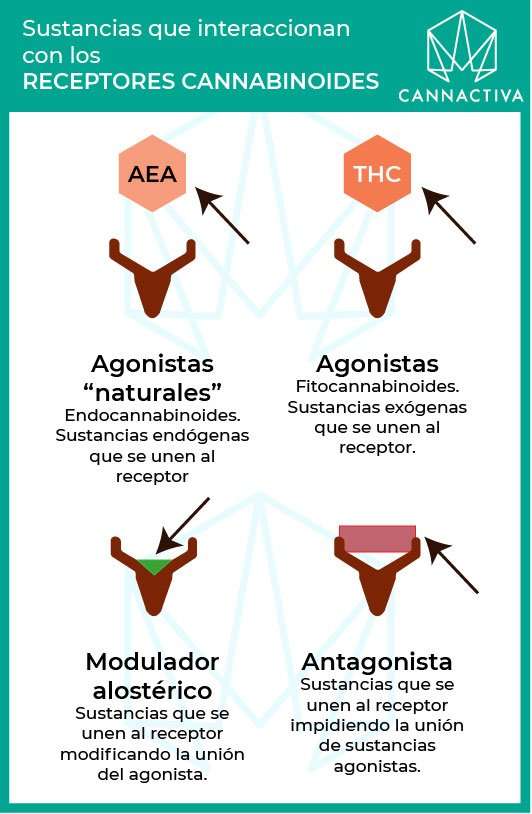
There are different substances that act on cannabinoid receptors. These interactions can be of different types:
- Natural agonists: The endocannabinoids are the natural agonist ligands of cannabinoid receptors, because they are the physiological or endogenous substances (produced by our body) that the cell receptor is “designed” for.
- Agonists: The cannabinoids in cannabis and synthetic cannabinoids are agonist ligands of cannabinoid receptors. An agonist is a substance capable of binding to a cell receptor and triggering a particular action in the cell, generally similar to that produced by a physiological substance. Although phytocannabinoids are structurally very different from endocannabinoids, they can bind to the same receptors. This binding can be total or partial.
- Allosteric modulators: Some cannabinoids (and other substances, such as terpenes) can bind partially to a receptor, changing the shape of the receptor and its binding with cannabinoids. These are what we call allosteric modulators. Modulators can be positive (they increase the affinity of cannabinoids for the receptor and enhance their effects) or negative (they decrease that affinity and reduce their effects).
- Antagonists: Finally, there are the antagonist ligands of cannabinoid receptors, which are molecules that block the receptor, preventing cannabinoids from binding. This is a natural self-regulation system of the cells, to limit the excessive activation of these receptors, but it can also be used pharmacologically to mitigate the effects of cannabinoids. Antagonists can be competitive (they compete with cannabinoids to bind to the receptors) or non-competitive. They can also be reversible or not…
CBD is an example of a negative allosteric modulator of the CB1 receptor. This means that its binding does not activate the receptor but rather decreases its activity. For this reason, CBD reduces the psychoactive effects of THC.
That covers the main interactions with cannabinoid receptors. Similar interactions also occur with cannabinoids and with the enzymes that break them down. By now, you can probably imagine how complex research into new cannabinoid substances is…
In conclusion...
Cannabinoid receptors are key components of the endocannabinoid system and play a crucial role in modulating physiological and biochemical functions in the human body. Their specific distribution and functions, both in the brain and in the immune system and other tissues, are fundamental to understanding the effects of cannabinoids and their therapeutic potential.
When this balance is disrupted, some researchers propose the existence of a clinical endocannabinoid deficiency, a theory that links the malfunctioning of the endocannabinoid system with certain ailments.
At Cannactiva we harness the synergy between cannabinoids and terpenes that acts on these receptors. Take a look at our full spectrum CBD oils or browse the full range of CBD oils.
Frequently asked questions about cannabinoid receptors (FAQ)
Why do we have cannabinoid receptors?
They did not evolve “for” cannabis. They have been present in all vertebrates for more than 600 million years and exist to respond to the endocannabinoids the body itself makes, such as anandamide. Their role is to help maintain the body's internal balance —homeostasis— regulating processes such as pain, mood, appetite and sleep. That the plant's cannabinoids fit into them is a biological coincidence.
Can cannabinoid receptors become desensitised?
Yes. Chronic, heavy use of THC can reduce the number and sensitivity of CB1 receptors (a process called downregulation), which is associated with tolerance. It is usually reversible after a period of abstinence. Because CBD does not directly activate these receptors, it does not produce this effect.
What is the difference between a cannabinoid receptor and an endocannabinoid?
The receptor is the “lock” located in the cell membrane; the endocannabinoid (such as anandamide or 2-AG) is the “key” the body produces to activate it. The phytocannabinoids in cannabis (THC, CBD) are external keys that also fit into those locks.
References
- Boggs, D. L., et al. (2018). Clinical and Preclinical Evidence for Functional Interactions of Cannabidiol and Δ9-Tetrahydrocannabinol. Neuropsychopharmacology, 43(1), 142-154. https://pubmed.ncbi.nlm.nih.gov/28875990/.
- Pertwee, R. G. (1997). Pharmacology of cannabinoid CB1 and CB2 receptors. Pharmacology & Therapeutics, 74(2), 129-180. https://pubmed.ncbi.nlm.nih.gov/9336020/.
- Shi, D., et al. (2014). Inhibiting CB1 receptors improves lipogenesis in an in vitro non-alcoholic fatty liver disease model. Lipids in Health and Disease, 13, 173. https://pubmed.ncbi.nlm.nih.gov/25406988/.
- Woodhams, S. G., et al. (2015). The role of the endocannabinoid system in pain. Handbook of Experimental Pharmacology, 227, 119-143. https://pubmed.ncbi.nlm.nih.gov/25846617/.
- Terral, G., et al. (2020). Cannabinoid Control of Olfactory Processes: The Where Matters. Genes (Basel), 11(4). https://www.ncbi.nlm.nih.gov/pmc/articles/PMC7230191/.
- Hillard, C. J. (2014). Stress regulates endocannabinoid-CB1 receptor signaling. Seminars in Immunology, 26(5), 380-388. https://www.ncbi.nlm.nih.gov/pmc/articles/PMC4247817/.