In the fascinating journey through the history of drugs, ancient Rome stands out as a civilisation that profoundly shaped our modern understanding of psychoactive substances. As in classical Greece, the term phármakon in Rome did not clearly distinguish between medicine and drug, covering both the idea of remedy and that of poison. This ambiguity contrasts sharply with contemporary culture, where a dividing line is often drawn between drugs and medicines.
Today on the Cannactiva blog we are joined by Jorge Melero and Jorge Escohotado, partners in La Emboscadura, the publishing house devoted to the work of Antonio Escohotado, author of the celebrated Historia General de las Drogas (General History of Drugs), to talk about the history of drugs in ancient Rome.
Drug laws in ancient Rome
The influence of Roman culture on the development of many disciplines is undeniable, and its approach to drugs is no exception. As in Greece, the concept of phármakon in Rome remained ambiguous, covering both remedy and poison.
Perhaps one of the most important parts of this civilisation’s legacy lies in its law, whose imprint is still present in today’s legal systems. So it is worth asking what Roman law said about these substances. Its position is reflected in the Lex Cornelia, the only Roman legal text we find relating to drugs, in force from the Roman Republic until the decline of the Empire: “drug is a neutral word, covering both what serves to kill and what serves to heal, as well as love potions, but this law condemns only what is used to kill someone.” (D’Ors, 1975, p. 699). In other words, the law only prohibited the use of drugs where there was an intention to kill; it also makes explicit the idea that a drug can serve both to kill and to heal.
Interestingly, Roman law focused on protecting users from scams and counterfeits, a common problem in the opium market, for example, where the quality of the product varied and it was often adulterated with other substances.
Antonio Escohotado argues that it is precisely this protection of the substance that prevented the social problems associated with its use, avoiding ignorance and marginalisation around it: “This explains why in Graeco-Roman culture – with millions of regular users over the centuries – its use did not produce the slightest sign of individual or collective problems” (Escohotado, 1998, p. 128).
Paradoxically, today Spanish law does not punish the adulteration of illicit substances, as long as they are adulterated with legal substances. In a way, the practice is even rewarded. When a trafficker is arrested with large quantities of illegal drugs, the penalty is based on the actual percentage of the illegal substance present.
Although the law does provide an aggravating factor for adulterating the substance with another that does greater direct harm to the user’s health, this provision is very weak, because the aggravating factor for a “substantial quantity” (notoria importancia) only applies above a threshold of seized illicit substance, and that threshold is calculated on the actual percentage of the illegal drug. For example, if a trafficker faces sentencing after X amount of suspected heroin has been seized, but the lab finds that only 20% of that amount is actually heroin, and that 20% does not exceed the threshold set for a substantial quantity, the aggravating factor will not apply. This happens even if the adulterant is more toxic than the drug itself, as long as it is legal. And it is precisely here that margins of relative impunity arise, which the new Spanish Penal Code has failed to correct, since it merely transcribed the old article 344.bis.a) without the slightest critical spirit. Consider, for example, a haul of 300 grams of heroin with a purity of 15 per cent heroin hydrochloride relative to the whole mixture. In this case the active ingredient would not exceed 45 grams, so the substantial quantity provision could not be applied, as it would not reach the 60-gram limit required for the specific aggravating factor to apply. (Porcellar, 1999, p.6)
This situation reveals a significant problem that goes beyond the authorities leaving consumers completely unprotected: it extends to the utterly irresponsible encouragement of practices so potentially harmful to public health.

Opium in Rome
Opium held a central place in Roman medicine, much as it did in ancient Greece. Pliny the Elder mentions that “the opium poppy always enjoyed favour among the Romans” (Theophrastus, 1988, p. 169), who used it both for its sedative properties and to bring on restful sleep. Using this drug was especially common and fully integrated into daily life: “For the Romans, the habit of taking opium was no different from the habit of eating certain foods, doing certain physical exercises or going to bed and getting up at a set time.” (Escohotado, 1998, p. 128).
There was a social consensus on two basic questions related to opium: the first was everyone’s basic right to fight pain and suffering using every means at their disposal; the second, the same right to decide to stop fighting and opt for sedation or euthanasia.
In ancient Mediterranean art, the opium poppy, from which opium is extracted, represents sleep and oblivion. Somnus, the personification of sleep, is depicted pouring poppy juice from a horn, known as the “opium horn”, onto the eyelids of sleepers (Escohotado, 1998).
Claudius Galen (129-199), the only physician of the classical era comparable to Hippocrates, established the therapeutic use of opium. Born in the city of Pergamon, known for its abundance of opium poppies and its temple to Asclepius, Galen saw poppy juice as the paradigm of a plant-based drug. For him, opium embodied the duality of being both a poison and a remedy; he saw in it a magical power to heal, and attributed this power precisely to the fact that it threatens to kill. Galen considered it “cold in the fourth degree”, whereas other drugs such as mandrake were considered third degree, and opium has “an incomparable soporific and analgesic power” (Escohotado, 1998, p. 127), which makes it an effective tool in many treatments, used in particular to lower body temperature or calm agitation.
In Galen’s view, opium was not simply a medical tool; it was a symbol of the complexity inherent in human nature and in medicine, hence his belief that its very danger is what makes it such a magnificent remedy.
Opium was not only a medicinal tool, but also a philosophical and existential resource. Its use for sedation, pain relief and inducing sleep resonated deeply with the Roman view of life and death. More than a right, euthanasia was seen as an ethical duty of the sick person and of those around them (Escohotado, 1998).
This idea of mors tempestiva was reflected in the philosophical texts of the time, where opium became a means of achieving moral autonomy, increasing man’s power to control his own destiny and ensuring a dignified death when life became unbearable.
The Roman opium market was complex and diverse, with demand outstripping supply. This led to a flourishing trade in Egyptian and Mesopotamian opium, exported mainly from Alexandria, and to a proliferation of counterfeits. Scribonius Largus, for example, stressed the importance of obtaining opium directly from the latex of the opium poppy, while Dioscorides and Pliny the Elder gave detailed criteria for avoiding fraud and judging the purity of opium (Escohotado, 1998), showing a deep familiarity with, and admiration for, the genuine product.
Moreover, it was forbidden to speculate on the price of this commodity: prices were set by the government, which prevented the free market, combined with excess demand, from leaving the poorest citizens without a good then considered an essential, like flour or wool. Finally, it is worth noting that a large share of tax revenue came from the opium trade.
Alcohol in ancient Rome
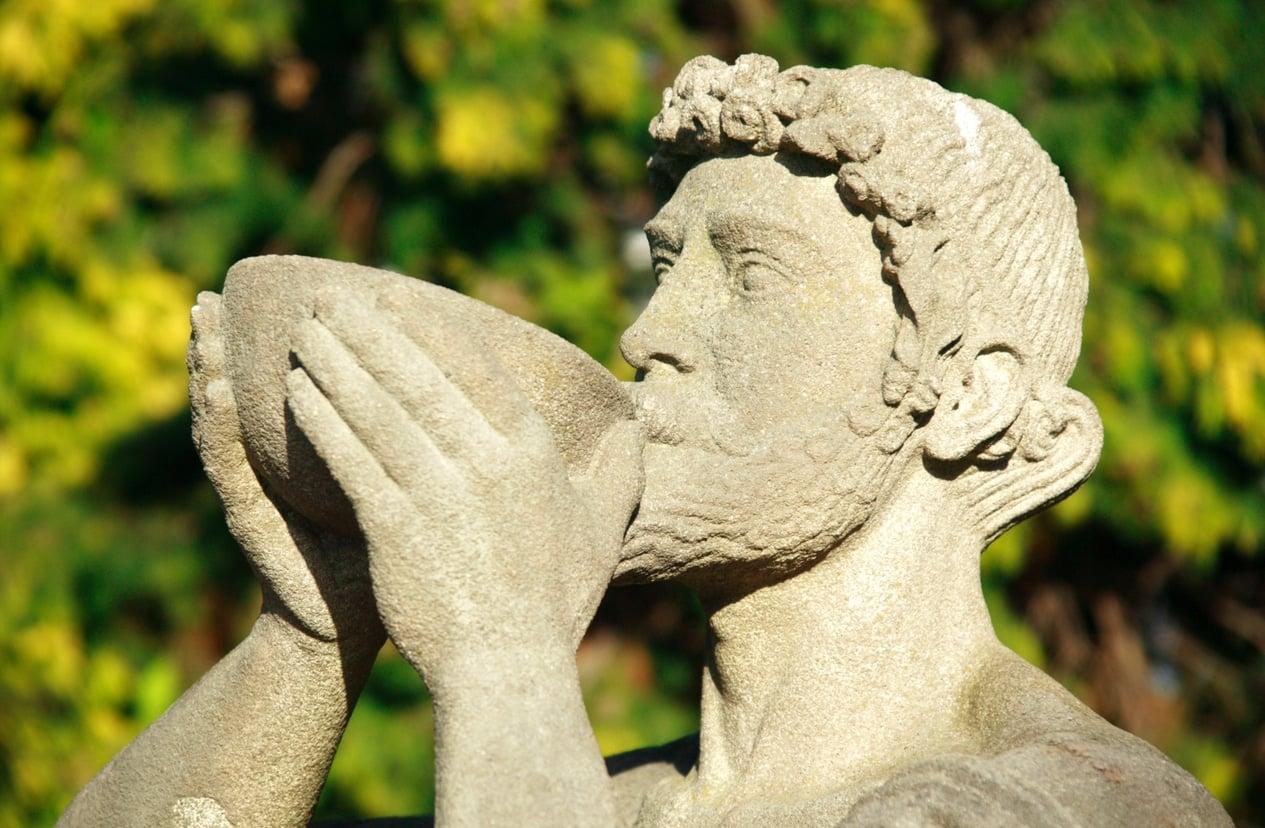
Wine was widely drunk by the Romans and played a central role in many aspects of their society. Writers such as Cicero and Pliny the Elder frequently mention wine drinking. At Roman banquets, wine was served in large quantities and was an essential part of hospitality and celebration. Wine was also used in religious rituals dedicated to gods such as Bacchus (Dionysus in Greek mythology), where it symbolised divine communion and purification.

The Bacchic cult, associated with the Greek god Dionysus, involved orgiastic rituals and mysteries that celebrated spiritual liberation through ecstasy and wine. When these practices reached Rome, they met strong resistance from Roman society and government, who were concerned about their destabilising potential.
Although the Romans were great wine drinkers, they imposed significant restrictions on drinking it. For example, people under thirty and women were traditionally excluded from the practice (Lewin, 1970).
In 186 BC, the consuls Spurius Postumius and Quintus Marcius learned of nocturnal bacchanals taking place in Rome, although this was nothing new: they had been going on for decades (Escohotado, 1998). The response was immediate and severe, marking the start of an unprecedented persecution.
At first, the bacchanals were exclusively female and were held three days a year. Over time, men were admitted and the ceremonies moved to night-time, extending to five dates a month. From then on, “no form of crime was left uncommitted” (Escohotado, 1998, p. 140) in these rites, which had grown to the point of almost forming “a second state” (Escohotado, 1998, p. 140), with the involvement of high-ranking individuals.
The crusade launched by Postumius ran into serious difficulties in identifying the citizens who took part in these rites. Until then, Roman law had dealt with one person’s intrusion on the freedoms of another, and had relied on complaints to resolve such incidents; however, nobody reported the bacchanals, as they did no direct harm to any individual.
The legal norms of the time would have required observers to infiltrate the ceremonies and specific crimes to be proven (Escohotado, 1998). Instead, “he set about attracting informers with rewards” (Escohotado, 1998, p. 140): in other words, any citizen who provided information about the bacchanals would receive a financial reward.
This method of using paid informers was new in Roman law and represented a direct intrusion on the individual freedoms of the population. More than 7,000 people are estimated to have been caught up in this persecution.

Conclusion
The use of drugs in the Roman Empire reveals a complex relationship between medicine, culture and the regulation of substances.
Opium, widely accepted and used, did not cause social problems or addictions as we understand them today. Rather than prohibiting, Roman law sought to regulate substances and guarantee their quality, protecting consumers from dangerous adulteration.
The harsh measures against the Bacchic cults reflect a concern for cultural and social stability more than for substance use itself.
Compared with contemporary policies, this approach invites us to reflect on how to balance regulation with respect for individual freedoms, without falling into paternalism that undermines personal autonomy and fuels irrational persecution.
Jorge Melero and Jorge Escohotado (Los Emboscados), Madrid, 28 December 2024
References
- Carod-Artal, F. J. (2013). Plantas psicoactivas en la antigua Grecia [Psychoactive plants in ancient Greece]. Neurosciences and History, 1(1), 28-38.
- Derrida, J. (1975). La farmacia de Platón [Plato’s pharmacy]. In La diseminación. Editorial Fundamentos. D’Ors, A. (1975). El digesto de Justiniano [The Digest of Justinian]. Editorial Aranzadi.
- Escohotado, A. (1998). Historia general de las drogas [General history of drugs]. Espasa.
- Hegel, G.W. (1978). Escritos de juventud [Early writings]. Fondo de Cultura Económica.
- Hippocrates. (1987). Tratados hipocráticos [Hippocratic treatises]. (García, C., Trans.). Editorial Gredos. (Original work published in the late 5th century BC).
- Hofmann, A., Wasson, R.G., Ruck, C. (2013). El camino a Eleusis. Una solución al enigma de los misterios [The road to Eleusis: unveiling the secret of the mysteries]. Fondo de Cultura Económica.
- Homer. (2001). Himno homérico a Deméter [Homeric Hymn to Demeter]. (Torres-Guerra, J.B., Trans.). Eunsa ediciones. (Original work published in the 7th century BC).
- Lewin, L. (1970). Phantastica. Payot.
- López, H. (2021). Las drogas en la farmacia de Platón [Drugs in Plato’s pharmacy]. El Hormiguero. Psicoanálisis, infancia/a y adolescencia/s. Retrieved from: https://revele.uncoma.edu.ar/index.php/psicohormiguero/article/view/3318
- Martín-Gutierrez, I. (2008). Los misterios de Eleusis [The mysteries of Eleusis]. Cannabis magazine, 39, 70-73.
- Nilsson, M.P. (1969). Historia de la religiosidad griega [History of Greek religion]. Editorial Gredos.
- Pabón, J.M. (2014). Diccionario manual griego. Griego clásico-español [Concise Greek dictionary: classical Greek-Spanish]. Vox Lenguas clásicas, p. 617.
- Parra, M. (1988). La hipótesis Sapir-Whorf [The Sapir-Whorf hypothesis]. Forma y Función, (3), 9-16. Retrieved from: https://revistas.unal.edu.co/index.php/formayfuncion/article/view/29488
- Plato. (2014). Las leyes [The Laws]. (Pabón, J.M., Trans.). Alianza editorial. (Original work published around 348 BC).
- Rodríguez, J.M. and Balma, Q. (2012). Las plantas y los hongos alucinógenos: reflexiones preliminares sobre su rol en la evolución humana [Hallucinogenic plants and fungi: preliminary reflections on their role in human evolution]. Reflexiones, 91(2), 9-32.
- Theophrastus. (1988). Historia de las plantas [Enquiry into plants]. (Díaz-Regañón, J.M., Trans.). Biblioteca clásica Gredos, 112. (Original work published around the 4th century BC).