The story of Albert Hofmann: more than the discoverer of LSD
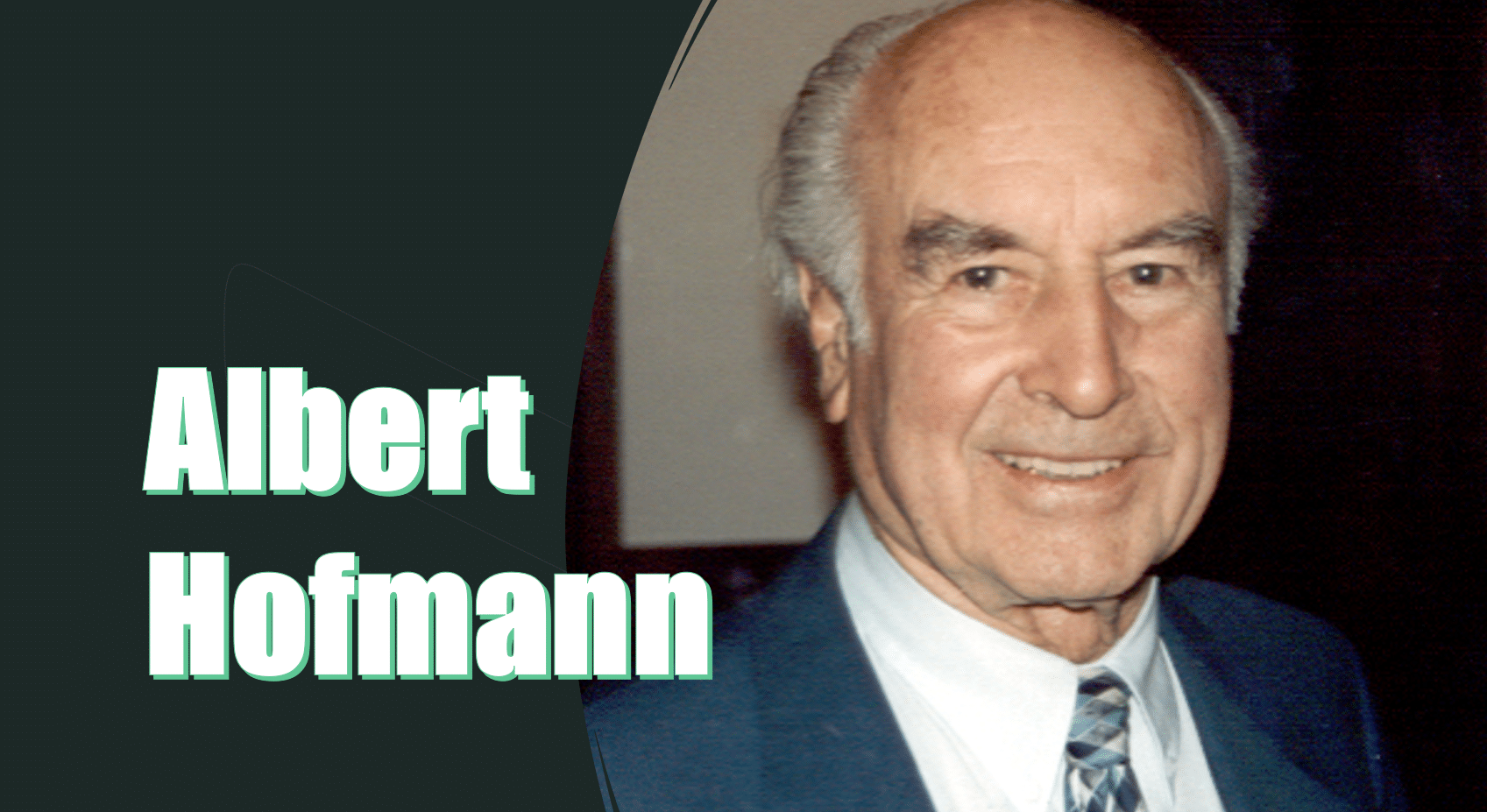
Albert Hofmann (1906-2008), Swiss chemist and discoverer of LSD, left an indelible mark on the history of science, culture and pharmacology. His discovery of LSD in 1938 transformed how psychoactive substances were seen in the West, challenging the boundaries between therapy, counterculture and spiritual exploration.
We tell his story in this article written by Jorge Melero and Jorge Escohotado, directors of La Emboscadura, the publishing house devoted to Antonio Escohotado, who, as well as being the author of the celebrated History of Drugs, was a close friend of Albert Hofmann.
A visionary scientist in times of change
The figure of Albert Hofmann (1906-2008) belongs to a complex historical context, in which the dialogue between science and culture was undergoing a profound transformation. Hofmann, a Swiss chemist linked to the prestigious pharmaceutical company Sandoz, is remembered for discovering lysergic acid diethylamide (LSD), a compound that would not only change the West’s perception of certain psychoactive substances but would, over time, call into question the very notion of a “drug” and the boundaries between therapy, inner exploration and counterculture.
Unlike in antiquity, when the concept of *phármakon *covered both remedy and poison, modern society drew a rigid line between the toxic, morally questionable drug and the legitimate medicine regulated by the state. LSD pushed this tension to the extreme, showing once again that no classification is static or definitive.
Albert Hofmann’s early years: nature, chemistry and ergot research
Albert Hofmann was born on 11 January 1906 in Baden, Switzerland, and from an early age showed an inclination towards nature, organic chemistry and the search for the mysteries hidden in the relationship between human beings and their surroundings. His studies at the University of Zurich gave him the basic tools to move into pharmacological research. At Sandoz, in the city of Basel, Hofmann began to study the alkaloids of rye ergot (Claviceps purpurea), a fungus with a rich tradition in the European pharmacopoeia which, since classical times, had attracted interest for its ambiguous properties, at once healing and dangerous (Escohotado, 1998).

The discovery of LSD: from intuition to revolution
In 1938, Hofmann synthesised LSD-25 for the first time, a derivative of ergoline, a class of ergot alkaloid. It was the 25th compound synthesised by the Swiss chemist during his research into lysergic acid derivatives, today known simply as LSD.
At the time, the finding attracted little attention: the compound did not seem to have any immediate therapeutic use, and it was shelved. However, Hofmann, guided by an intuition that he himself would describe as a kind of “inner call”, decided to return to the substance five years later. It was in the spring of 1943, amid the global chaos of the Second World War, that he carried out a new synthesis and came into accidental contact with small amounts of the compound. This episode would mark a turning point, as Hofmann noticed perceptual and sensory changes that he found as surprising as they were unsettling.

Three days later, on 19 April 1943, he deliberately took a dose of LSD that he believed to be minimal in order to understand its effects. The famous bicycle ride from the laboratory to his home, remembered as “Bicycle Day”, would become a kind of founding milestone of psychedelic research. That sensory, introspective and deeply transformative experience showed that LSD could alter consciousness in an unprecedented way, opening the door to new fields of psychiatric, psychological and philosophical research.
The history of LSD: from therapeutic research to cultural revolution
LSD was received with ambivalence at first. During the 1950s, the world was living through the effects of the post-war period and the rise of modern psychiatry. Psychiatrists, neurologists and psychologists explored its therapeutic potential with an interest reminiscent of the practices of antiquity, when no sharp line was drawn between remedy and visionary substance. LSD entered academic and medical circles: it was used to treat addictions such as alcoholism, treatment-resistant depression and other disorders, with mixed but promising results (Carod-Artal, 2013).
However, this medical and scientific enthusiasm was overtaken by the cultural and political dynamics of the 1960s. Under the influence of major figures such as Timothy Leary, Aldous Huxley and Ken Kesey, LSD moved beyond the clinical sphere and became a symbol, a catalyst for cultural revolution, political protest and spiritual exploration.

The mass, indiscriminate adoption of LSD worried figures such as Albert Hofmann himself, who warned against irresponsible use of the substance outside a controlled therapeutic setting.
Hofmann’s concern about the use of LSD
Hofmann himself repeatedly voiced his concern about irresponsible use of the substance outside a therapeutic context. In his memoirs, he stressed that LSD could be a “medicine for the soul”, provided it was used with rigour, respect, clear guidelines and supervision, recalling the cautious attitude of the Hippocratic physicians or the religious rules of ancient cults. However, faced with youthful euphoria and scandalised authorities, medical research was soon obstructed. Just as in classical Rome the Bacchic cult went from being a festive celebration to an object of persecution (Escohotado, 2021, p. 140), LSD went from therapeutic recognition to the status of a banned and demonised drug.
Covert programmes and political double standards
The signing of international conventions and the tightening of domestic regulations in many countries, including the United States, placed LSD in Schedule I of controlled substances, putting it on a par with compounds with no recognised medical value and a high potential for abuse (Hofmann et al., 2013).
Paradoxically, while its study was being restricted in academic circles, government bodies such as the CIA ran covert programmes — such as the notorious MK-Ultra — using LSD for mind control, espionage and psychological warfare, which shows the double standards often adopted by political power (Hinojosa, 2020, p. 4).
The psychedelic renaissance of the 21st century
Towards the end of the 20th century, and more markedly in the 21st, the situation slowly began to change. New research, backed by growing evidence of the therapeutic potential of psychedelic substances in controlled settings, has led to renewed scientific interest in LSD, psilocybin and related compounds. This renaissance echoes Hofmann’s warning about the need to overcome prejudice and explore pharmacology with rigour and curiosity, not with the aim of “intoxicating” society, but of finding valuable tools for mental health, creativity and self-knowledge.

The friendship between Albert Hofmann and Antonio Escohotado
It is almost essential to mention the fine friendship Hofmann had with the Madrid-born thinker Antonio Escohotado, with whom he shared such a close intellectual and spiritual affinity that they used to call each other “father and son”. Each deeply admired the other, and they found in their conversations fertile ground for exploring the philosophical, cultural and therapeutic implications of entheogens.
On one memorable occasion, Hofmann, Escohotado, Jonathan Ott and Alexander Shulgin, godfather of MDMA and father of 2C-B – and author of PiHKAL and TiHKAL, whose new Spanish editions La Emboscadura is publishing – all came together at the El Escorial Summer Courses. These four were the most important people in the world in the field of pharmacology. It is in the very works we have mentioned that this experience is told from the point of view of both Shulgin and Escohotado:
On at least two occasions the Felipe II was a hotel overrun by psychedelia, where not only students but secretaries, barmen and the lift attendant swapped experiences with the speakers. Held on the eve of the day off, these sessions were timed by calculating the peaks and plateaus of each substance, so that the high would start to build around 3 o’clock, and as far as I know everyone had a good trip despite there being so many of us. (Shulgin, 2025)
After discovering LSD, Hofmann continued to work at Sandoz as head of research in the Natural Products Department until he retired in 1971. As well as discovering LSD, he was the first to synthesise psilocybin (an active component of hallucinogenic mushrooms), in 1958; he discovered other hallucinogenic principles in Ololiuqui (morning glory), lysergic acid amide and lysergic acid hydroxyethylamide. He also contributed to the development of medicines such as Hydergine (for cerebral circulation) and dihydroergotamine (to stabilise blood pressure).
In 1979, Hofmann published his book LSD: My Problem Child , a work in which he reflected on the discovery of LSD and the events that turned it into a symbol of the counterculture. The book was written when the substance was banned and research into it severely restricted, and it offers a personal and critical view of LSD’s therapeutic uses, its cultural impact and the controversies surrounding its popularisation. Hofmann believed that LSD had great potential for addressing modern psychological problems such as disconnection, materialism and a lack of purpose in contemporary society, and felt that his discovery should be used in therapeutic and spiritual contexts, not recreational ones. It is considered an essential work for understanding both the science and the philosophy behind LSD.
The legacy of Albert Hofmann
Albert Hofmann died in 2008, at the age of 102, having witnessed the whole historical arc of LSD: from its discovery in a modest laboratory synthesis to its enthronement as a countercultural icon, its legal prohibition and its slow resurgence in the clinical field. He embodies the paradox of the phármakon in modern times: a substance capable of arousing fears, dogmas and prohibitions while at the same time holding therapeutic and spiritual promise. Hofmann’s legacy thus invites us to reflect critically on prohibitionist policies, moral outlooks and the importance of dispassionate, evidence-based analysis that allows us to balance the needs of public health, individual freedom and scientific progress.

So, in recalling the story of Albert Hofmann and LSD, we return to a fundamental dilemma: which substances deserve to be persecuted, revered, understood or studied? The answer, like so many others in the field of psychoactives, is complex. But Hofmann reminds us that, unless legal barriers and political inertia are reconsidered, we risk losing valuable opportunities to improve our understanding of human consciousness, thereby perpetuating a collective blindness towards tools that, used well, could have a positive impact on the wellbeing and freedom of the individual.
Jorge Melero and Jorge Escohotado (Los Emboscados), Madrid, 28 December 2024
Bibliography
- Carod-Artal, F. J. (2013). Psychoactive plants in ancient Greece. Neurosciences and History, 1(1), 28-38.
- Escohotado, A. (1998). Historia general de las drogas. Espasa.
- Escohotado, A. (2021). Majesties, crimes and victims. Emboscadura editorial.
- Hofmann, A., Wasson, R.G., Ruck, C. (2013). The road to Eleusis. A solution to the riddle of the mysteries. Fondo de cultura económica.
- Hinojosa, M. (2020). Timothy Leary. The high priest of the new consciousness. Cannabis Magazine.
- Shulgin, A. (2025) TiHKAL. Narrative part. La Emboscadura.