Portugal seems to be fairly liberal when it comes to drug policy, including cannabis. The country is full of international facilities devoted to producing medical cannabis, but the question arises: what is the situation for cannabis users, and how does CBD fit into this picture? In 2023 I had the opportunity to interview Laura Ramos, a Portuguese journalist, founder of Cannareporter and editor-in-chief of Cannadouro Magazine.
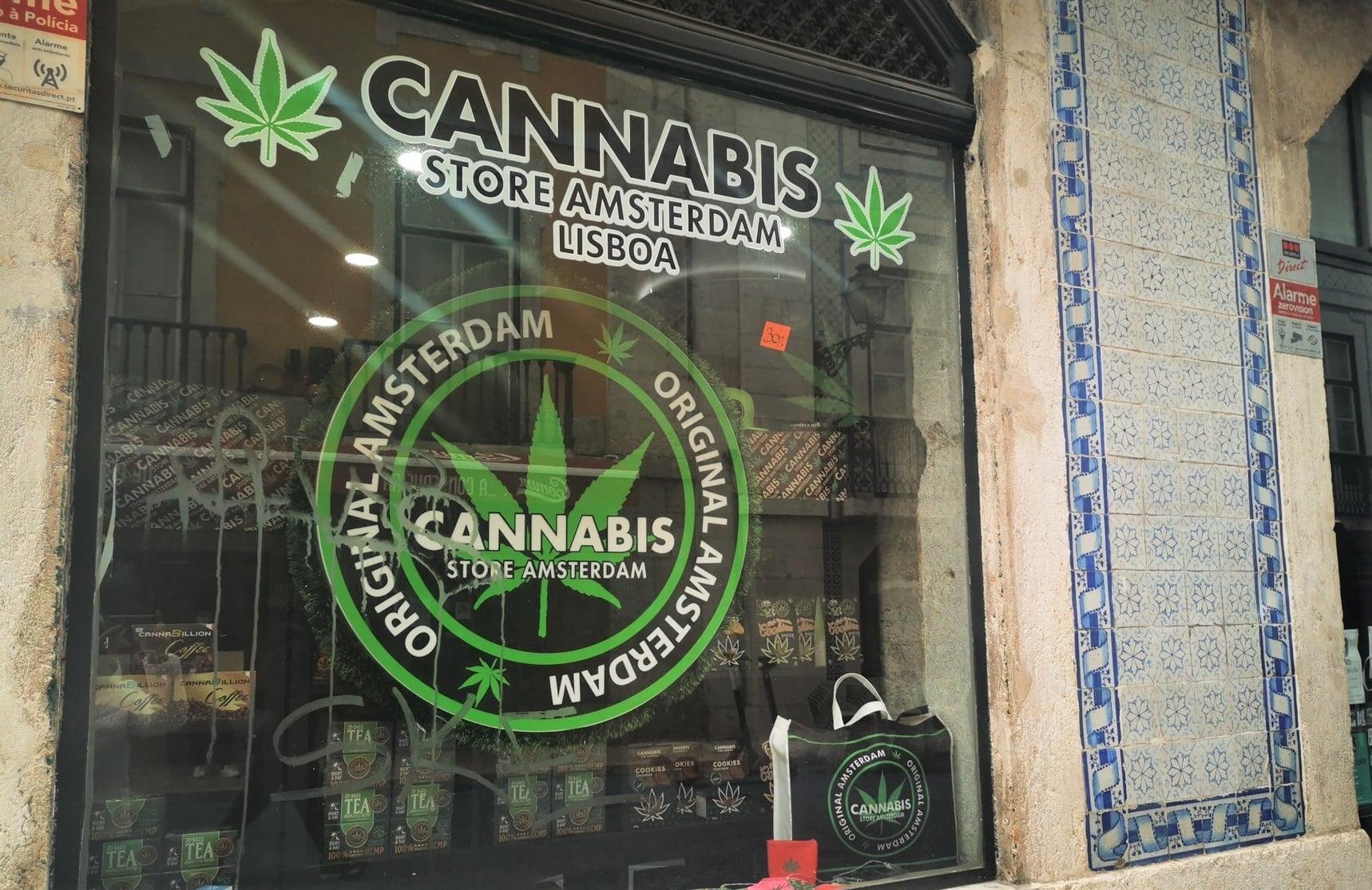
Cover photo: cannabis shop in Lisbon. Photo: Laura Ramos | Cannareporter
Is CBD legal in Portugal and, if so, in what forms and under which laws?
There are plenty of CBD products available all over Portugal, but they are not regulated. When Portugal legalised cannabis for medical purposes, all CBD supplements were withdrawn from health food and dietary supplement shops. Then Infarmed, our health authority, said that CBD could only be authorised as a medicine, but to date they have not authorised any, also because no company has asked them to authorise a medicinal CBD product for the market. The DGAV – Directorate-General for Food and Veterinary Affairs says that CBD is an unauthorised “novel food” and, as such, cannot be sold. In Portugal, hemp can only be grown or sold for fibre and/or seeds.
OK, in theory CBD can't be sold in Portugal, but what happens in real life?
In reality, many retailers and shops sell CBD flower, CBD oil and CBD food products in Portugal. There have already been some court cases, after the police seized products of this kind, in which the court ordered the Judicial Police to return the CBD-rich hemp flower to the retailers it had been seized from. In those cases, the court stated that hemp flower with less than 0.3% THC is not considered a narcotic.
So, is it legal to sell CBD-rich flower with less than 0.3% THC in Portugal?
In theory, no. The law regulating hemp growing says that CBD flower cannot leave the farmer's property, and hemp can only be produced for seeds and/or fibre. In practice, however, CBD products are on sale everywhere, so they are not hard to find. But they are neither verified nor regulated, and they are often labelled as “souvenirs” or “decorative items” to get around strict regulations.
Portugal has more than 100 cannabis shops, around 30 of them in Lisbon. CBD is widely used by thousands of patients in a range of products.

What is the legal THC limit?
Portugal follows the European Commission's guidelines, so, like every other European country (except those that have decided otherwise, such as the Czech Republic, where it is 1%), it is now 0.3% THC.
Are there many CBD shops in the big cities? Do you have any idea, for example, how many there are in central Lisbon? Dozens, hundreds?
There are at least more than 100 physical cannabis shops across Portugal, not just in the biggest cities. Lisbon probably has more than 30. If we count online shops, the number goes up, but there is no official data that can confirm any of these figures.
Do you have any estimate of how many Portuguese people use cannabis or CBD products?
We have no official data, but certainly thousands of people, most of them patients, are using all kinds of CBD products, from oils to flower, edibles and drinks. Many people buy from “cannabis shops”, others make their own products, and a great many people still rely on the illicit market.
According to a 2021 survey by the Portuguese Institute on Drugs and Addictions (SICAD), with a sample of 3,188 people who had used cannabis, 3,019 had used illegal cannabis (95%) and 614 had used legal cannabis (19%) – and here SICAD said that “legal cannabis” means “CBD products and/or products with a low THC content, sold in shops” – and only 2 people had used cannabis prescribed by a doctor (0.1%). The survey noted that “almost all legal cannabis users are at the same time illegal cannabis users” and “only 38 used legal cannabis exclusively (1%)”.
What is the policy on “recreational” cannabis with more THC?
Portugal decriminalised the use and possession of small amounts of all drugs for personal use in 2001. This means that when the police catch someone with a certain amount of cannabis, that person may be required to appear before a Commission for the Dissuasion of Drug Addiction, or else pay a fine. This is better than getting a criminal record or going to trial, as it is only a few sessions with a health team to assess the individual situation, but it is drawing in more people year after year. This is not due to problems from cannabis use, but rather to stricter enforcement by the police, who refer all users to these commissions or to court. Cannabis-related seizures are the most frequent in Portugal, with many cases of people growing at home for their own use who end up in court or even in prison. So decriminalisation is not the paradise in Portugal that many people might imagine. There is still a great deal of prejudice and misinformation.
How widespread is the use of THC-rich cannabis, and is it rising or falling? What about young people?
According to data reported by SICAD, in 2018 there were around 500,000 regular cannabis users, two thirds of whom used it four or more times a week. At the time, the report pointed to a slight upward trend, especially among Portuguese people aged 25 to 44, but that was the latest data we had. A report on drug use published by the European Monitoring Centre for Drugs and Drug Addiction (EMCDDA) in 2021 found that Portugal is the second country in Europe where cannabis is used most regularly, behind only Spain. Cannabis is the illicit substance that young people start using earliest, at an average age of 17, but unlike adults aged 25 to 44, the youngest people in Portugal (aged 15 to 24) have shown a drop in use.
Is medical cannabis legal in Portugal? What does it look like on paper and in practice?
Medical cannabis was approved in Portugal in 2018 and regulated in January 2019, although patients still struggle to obtain suitable cannabis-based medicines. Legalisation was very beneficial for all the companies that came to Portugal to produce cannabis for medical purposes for export. Today, Portugal is one of the largest cannabis producers, but only two medicines can be prescribed by doctors and found in pharmacies: the oral spray Sativex and Tilray's 18% THC flower. Nothing else is available on prescription. Another important point is that medical cannabis is not yet taught at universities, and doctors still lack training in this field, so they do not feel comfortable prescribing it. In practice, most patients act as their own doctors and still buy cannabis on the illicit market.
Can I get medical cannabis, for example for depression, in your country?
No, not for depression (yet). When Infarmed regulated the medical cannabis law, they said that any doctor can prescribe cannabis, including GPs, but they only included seven therapeutic indications for which doctors can prescribe it, and only when all other medical options have failed. The list of therapeutic indications considered appropriate for cannabis-based preparations and substances in Portugal is as follows:
- Spasticity associated with multiple sclerosis or spinal cord injury;
- Nausea, vomiting (resulting from chemotherapy, radiotherapy and combination therapy with HIV and hepatitis C medicines);
- Appetite stimulation in the palliative care of patients undergoing cancer treatment or with AIDS;
- Chronic pain (associated with cancer or nervous system diseases, such as neuropathic pain caused by nerve damage, phantom limb pain, trigeminal neuralgia or after shingles);
- Gilles de la Tourette syndrome;
- Epilepsy and treatment of severe seizure disorders in childhood, such as Dravet and Lennox-Gastaut syndromes;
- Treatment-resistant glaucoma.
According to Infarmed, this list may grow, provided they have sufficient evidence to demonstrate the health benefits.
Are there any trends we should know about? Will Portugal legalise and regulate cannabis in the near future, or should we expect a change of direction?
Unfortunately, and despite the various bills put before Parliament, I don't think cannabis legalisation will happen in Portugal in the near future. At least, I don't think Portugal will move ahead of Germany. Some people I have interviewed over the past few years have said they would rather wait and see other countries' experiences than move forward with legalisation on their own. However, with two bills to be debated in 2023 and a majority of members of Parliament in favour of legalisation, anything could happen. Politics depends heavily on external factors, so we will see what happens.
About Laura Ramos

Laura Ramos is a journalist, editor-in-chief at Cannareporter and Cannadouro Magazine and programme curator at PTMC – Portugal Medical Cannabis.
With a degree in Journalism from the University of Coimbra, Laura Ramos has worked as a writer and reporter for various media outlets, from national television (RTP) to newspapers and magazines such as Euronotícias, A Capital and Sábado.
She was a news correspondent for the daily “Jornal de Notícias” in Rome, Italy, in 2004/2005, where she did postgraduate studies in Photography. Laura then became Head of Press at the Ministry of Education, and also created the street art photo archive “Say What Lisbon?”.
Laura is currently editor-in-chief of the news website CannaReporter and of Cannadouro Magazine, and directed the documentary “Pacientes”, about medical cannabis users, which was presented to the Health Committee of the Portuguese Parliament in 2018.
She is co-founder of PTMC – Portugal Medical Cannabis, where she works as programme curator, and coordinated three international conferences that welcomed more than 1,000 attendees from 25 different nationalities.
Laura was also involved in organising the first Postgraduate Programme in Good Manufacturing Practice for Medical Cannabis in Portugal, in 2019, in partnership with the Military Laboratory of Chemical and Pharmaceutical Products and the Faculty of Pharmacy of the University of Lisbon.
* Interview adapted from the original by Cannactiva.