Cannabinoid biosynthesis: how are CBD and THC produced?
One of the greatest pleasures of knowledge is discovering that it never ends. The topic we're covering on the blog today is cannabinoid synthesis, or biosynthesis. And why does it matter to study how cannabinoids are produced? Well, for lots of reasons, actually.
The fascinating world of cannabinoid biosynthesis
Cannabinoid biosynthesis is an area of great research interest in the cannabis industry and in medicine, as these compounds have a wide range of potential therapeutic properties.
Understanding the processes that produce cannabinoids can help improve the production of specific cannabinoids for use in medical treatments. But understanding the complexity of this process also lets us better grasp how arbitrary the permitted THC limits for cannabis are, which in many countries are below 1%, something utterly ridiculous, as it goes against biology itself.
What is cannabinoid biosynthesis?
Cannabis plants produce chemical compounds known as phytocannabinoids through a biological process called cannabinoid biosynthesis. This process takes place in the cannabis trichomes.
The biochemical pathway of cannabinoid synthesis
The biochemical pathway that produces the cannabinoids we know is a long one, and it involves non-cannabinoid substances, cannabinoids and enzymes.
Also, as a curiosity, in the cannabis plant the upstream steps of cannabinoid biosynthesis converge with the terpene pathway.
It all starts with CBGA (cannabigerolic acid), the mother of the other cannabinoids, from which THCA (Δ-9-tetrahydrocannabinolic acid), CBDA (cannabidiolic acid) and CBCA (cannabichromenic acid) are produced. And although we don't fully understand the pathway of other cannabinoids, cannabis produces around a hundred different cannabinoids!
As we mentioned in an earlier article, the Cannabis sativa plant produces cannabinoid compounds in acidic form, shown by an “A” at the end of each cannabinoid's name (e.g. CBDA, THCA).
The cannabis plant produces cannabinoids in acid form, and when heated they change to their neutral form through a process called decarboxylation.
When they are heated, a chemical process called decarboxylation takes place, in which these compounds change to their neutral form [1]. During this chemical process, the cannabinoids in acid form lose a carboxyl group (COOH) and form CBD (cannabidiol), THC (Δ-9-tetrahydrocannabinol) and CBC (cannabichromene).
This neutral form of cannabinoids is the one that interacts most with our endocannabinoid system [2]. That is why, to get the effect of cannabis, we smoke, vape, infuse or cook the plant.
This decarboxylation process happens outside the plant. In other words, the plant produces the compounds in acid form, and the neutral form comes about outside it, which I label in the figure as a “non-enzymatic conversion”.
The enzymes of cannabinoid biosynthesis
What are enzymes?
Cannabinoid synthesis inside the plant happens thanks to proteins called enzymes. To keep it simple, we could say that enzymes are a type of protein that performs a function: they do something. In this case, the enzymes of cannabinoid synthesis act like an architect that modifies or transforms one molecule into another.
In reality, these changes happen in many ways: sometimes by trimming the chemical molecule, other times by folding it, or by attaching a chemical group, and so on. In cannabis, cannabinoid biosynthesis begins with the enzyme CBGAS (cannabigerolic acid synthase), which is the one that produces the “mother cannabinoid”: CBGA.
Then there are enzymes responsible for transforming CBGA into other cannabinoids: THC synthase, CBD synthase and CBCA synthase. So far it all looks very neat and simple, doesn't it? Well, it isn't always so: as we'll see, these enzymes have a lot to say.
The mother cannabinoid: CBGA
The three enzymes, THCA, CBDA and CBCA synthases, act on CBGA, which is the precursor of these three cannabinoids. So CBGA is the mother that gives birth to these cannabinoids. This is one of the reasons I like CBGA: as a mother, I identify with other mothers.
CBGA is the cannabinoid that the cannabis plant's enzymes use to produce the cannabinoids THCA, CBDA and CBCA, and that is why it is known as the mother cannabinoid.
In the figure I show the last two of the very many steps that take place inside the plant in cannabinoid biosynthesis:
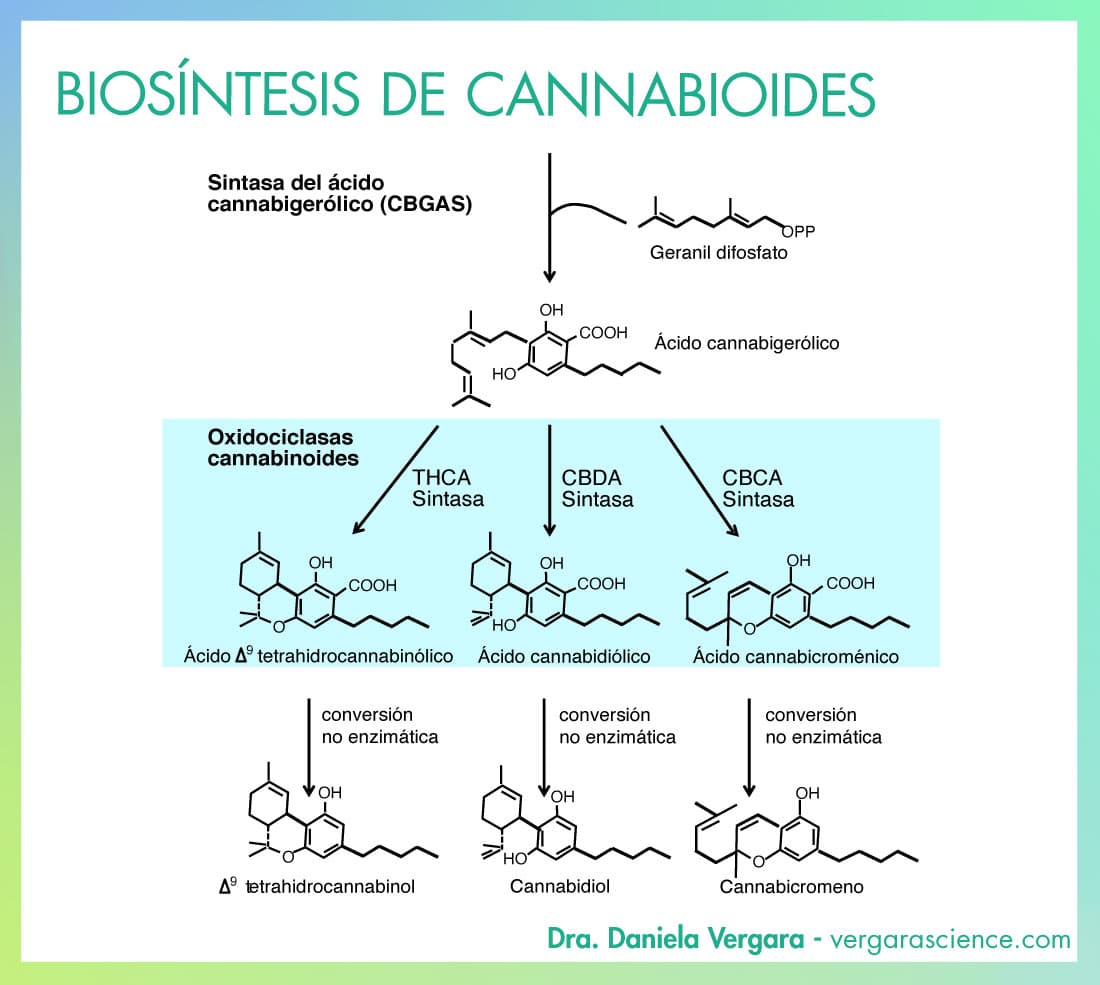
The figure shows the last steps of the metabolic pathway that produces the cannabinoids CBC, CBD and THC. The CBGA synthase enzyme (CBGAS) converts geranyl diphosphate into cannabigerolic acid (CBGA). CBGA is the precursor molecule used by the THCA, CBDA and CBCA synthase enzymes to produce the cannabinoids THCA, CBDA and CBCA, respectively. When heated, these three compounds, like CBGA, decarboxylate and change to their neutral forms THC, CBD, CBC and CBG. This decarboxylation step happens outside the plant, which is what I call a “non-enzymatic conversion”.
The cannabinoid great-grandmother
Wondering what the ancestor of cannabinoids is? If CBGA is the mother cannabinoid, the great-grandmother of all cannabinoids is palmitic acid. Like endocannabinoids, phytocannabinoids are synthesised from fatty acids.
Promiscuous and sloppy enzymes: out partying!
As you can see in the figure, many different enzymes are involved in cannabinoid synthesis. These proteins do a job, in this case as synthases, since they catalyse (cause, trigger) a reaction that gives rise to the different cannabinoids.
The CBGAS enzyme (cannabigerolic acid synthase) is the one that converts olivetolic acid (OLA; derived from palmitic acid) and geranyl diphosphate into cannabigerolic acid. Chemist readers can tell me whether I am translating these names properly from English into Spanish.
The cannabinoid oxidocyclases are the well-known THCA synthase, CBDA synthase and CBCA synthase, which take cannabigerolic acid and convert it into THCA, CBDA and CBCA, respectively.
In terms of chemical structure, CBDA has one extra ring structure compared with the CBGA synthase enzyme. This structural difference translates into differences in their biological effects.
I take this term, “cannabinoid oxidocyclases”, which I love, from the 2021 paper by van Velzen and Schranz [7], and I recommend it to you.
As a curiosity, if we get biochemical, this is why van Velzen and Schranz call the THCA, CBDA and CBCA synthases cannabinoid oxidocyclases: “oxido” because they remove a hydrogen from CBGA, and “cyclases” because the cannabinoids THCA, CBDA and CBCA all have one more ring.
Characteristics of the cannabinoid synthesis enzymes
Now, although many of us were taught as undergraduates that enzymes are highly specific, like a key to a lock, this is not the case with cannabinoid oxidocyclases (THCA, CBDA and CBCA synthases).
The enzymes involved in cannabinoid synthesis can produce up to eight different compounds in vitro, including each other's compound [8]. And it seems that in the living plant (in vivo), too, these enzymes are not very specific [8], although many studies are needed to confirm what these enzymes are producing in the plant, and in what amounts.
In other words: the enzyme that produces THCA (THCA synthase) can, as well as producing THCA, produce CBCA and CBDA. The same goes for CBDA synthase: it can also produce THCA and CBCA, and so on, up to eight compounds.
In English this is called “sloppiness”, which is why I call them sloppy enzymes. And according to my hypothesis, which is yet to be confirmed, the sloppiest of them all is CBCA synthase, but that is another story for another day.
The enzymes that produce cannabinoids are promiscuous and sloppy: they can produce up to eight different cannabinoids in vitro, including each other's.
What's more, since these three enzymes use CBGA as their precursor compound, and it is the same compound all three act on, they could also be classed as promiscuous enzymes.
As you can see, our little enzyme friends are out partying, promiscuous and sloppy, producing one another's compound, or other compounds here and there, any old how, a la topa tolondra as they say in Colombia (and if you ever go to Cali, Colombia, I recommend going dancing at the club of that name).
CBGA synthase: the intriguing genetic structure of the mother cannabinoid's enzyme
Something I have found rather interesting is the genetic structure of the gene that codes for the CBGA synthase enzyme. This gene has many exons, and therefore introns too [6]. Exons are the part of the gene that carries the information for producing proteins, whereas introns carry no information.
Although both exons and introns are found in the DNA, or genetic material, of cannabis, as part of the gene that produces CBGAS, when the enzyme or protein is produced, it only carries the genetic information from the exons.
Characteristics of the CBGAS enzyme
What I find interesting about this genetic structure is that the introns are quite large, up to almost 11,000 nitrogenous base pairs (letters; [6]), and although introns of this size have been reported, they are not that common.
On top of that, this gene has many introns: nine, ten and even eleven [6].
So it is a gene made up of quite a few pieces, which is also interesting because several types of protein can be produced, something that will hopefully be studied scientifically in the near future.
The gene that codes for the CBGA synthase enzyme has an interesting structure with several exons and introns. Exons are the part of the gene that is translated into protein, and having several of them makes it possible to form different protein structures.
This is another reason why CBGA is my favourite cannabinoid: although scientific studies are still needed to confirm this hypothesis, the gene may perhaps produce different protein structures, making it versatile, adaptable and generous, as we mothers are.
How are the minor cannabinoids CBCA and CBGA produced?
Because many cannabinoids, such as CBCA and CBGA, are produced in the cannabis plant in small amounts, especially compared with THCA and CBDA [9], they are known as minor cannabinoids. Even so, they appear to have pharmacological properties and possible medicinal uses.
Synthesis of minor cannabinoids
There are many other minor cannabinoids, such as CBCA and CBGA, and THCVA and CBDVA.
These are produced through an alternative pathway that uses divarinic acid instead of olivetolic acid, and we will talk about them another time.
Other cannabinoids, such as CBN, are produced by oxidation (without enzymes) from THC, which means CBN could be classed as a breakdown product.
Cannabinoid enzymes and their role in the cannabinoid profile of cannabis strains
Is it possible to choose which cannabinoids we want a cannabis plant to produce?
For many years, and in secret, the methods used to choose which cannabinoids we want a plant to produce relied on artificial selection, that is, selecting plants with the desired traits based on aroma, potency, vigour…
Cannabis growers had an informal understanding of cannabinoid biosynthesis long before scientists described these chemical reactions.
Artificial selection has been used in many plants and other organisms. In dogs, for example, to obtain varieties, or different breeds (cultivars, if we apply it to cannabis), with desired traits.
But behind this ancient technique lies cannabinoid chemistry. For example, THC-free cannabis has been obtained by crossing high-CBD strains. Genetically, cannabis plants that are very high in CBD have a truncated or faulty gene for the THCA synthase enzyme, so the plant does not produce the cannabinoid THC, or not as much of it (because, remember, these are sloppy enzymes), and other cannabinoids, such as CBD, build up instead.
Conversely, strains that are very high in THC, with very psychoactive effects, tend to have a faulty CBDA synthase gene.
This is one of the reasons why cannabinoid production in cannabis plants can vary significantly depending on genetics, although growing conditions also play a part (lighting, watering, soil pH, temperature…).
Cannabinoids made to order? It's not that easy
You might think that, if we want strains that don't produce a certain type of cannabinoid, we could silence the genes that produce the corresponding synthase enzyme. But that isn't the case: as we have seen, these enzymes are sloppy, and in theory all of them are capable of producing THC; in practice we see that plants producing high levels of CBD usually also contain THC, even if only in small amounts.
Ignorant pettifoggers
It is quite likely that the lawmakers who wrote the rules on hemp and cannabis had no idea these enzymes were out partying. Because had they known that cannabinoid enzymes were promiscuous and sloppy, they might have set the THC limit higher than 0.3%, which would be more in line with the plant's biology, or set no limit at all.
Lawmakers' and regulators' profound ignorance of the plant's biochemistry and biology harms cannabis growers, producers and breeders.
On a previous occasion I told you about my deep anger and frustration at these unfair and absurd regulations on the types of cannabis.
If you come across these ignorant pettifoggers, tell them there is an evolutionary biologist and cannabis researcher out there strongly criticising their uninformed, thoughtless and selfish decisions.
Information on cannabinoid synthesis (frequently asked questions)
What is cannabinoid synthesis?
Cannabinoid biosynthesis describes the chemical reactions that take place in the cannabis plant and give rise to cannabinoids. The cannabinoid biosynthesis process involves a series of enzymatic steps that convert chemical precursors into active cannabinoids. The main precursor of cannabinoids is cannabigerolic acid (CBGA), which is converted into THC, CBC or CBD through the action of specific enzymes.
Where does cannabinoid synthesis take place?
In cannabis plants, cannabinoid biosynthesis takes place in the glandular trichomes, specialised structures found on the surface of the leaves, stems and, above all, the flowers of the plant. However, synthetic cannabinoids can also be produced.
References
- Hart, C.L., et al., Effects of acute smoked marijuana on complex cognitive performance00273-1). Neuropsychopharmacology, 2001. 25(5): p. 757-765.
- Gertsch, J., et al., Beta-caryophyllene is a dietary cannabinoid. Proceedings of the National Academy of Sciences, 2008. 105(26): p. 9099-9104.
- Page, J.E. and J.M. Stout, Cannabichromenic acid synthase from Cannabis sativa. 2017, Google Patents.
- Vergara, D., et al., Gene copy number is associated with phytochemistry in Cannabis sativa. AoB PLANTS, 2019. 11(6): p. plz074.
- Gülck, T. and B.L. Møller, Phytocannabinoids: origins and biosynthesis. Trends in Plant Science, 2020. 25(10): p. 985-1004.
- Innes, P.A. and D. Vergara, Genomic description of critical upstream cannabinoid biosynthesis genes. bioRxiv, 2022: p. 2022.12.15.520586.
- van Velzen, R. and M.E. Schranz, Origin and evolution of the cannabinoid oxidocyclase gene family. Genome Biology and Evolution, 2021. 13(8): p. evab130.
- Zirpel, B., O. Kayser, and F. Stehle, Elucidation of structure-function relationship of THCA and CBDA synthase from Cannabis sativa L.. Journal of Biotechnology, 2018. 284: p. 17-26.
- Smith, C.J., et al., The phytochemical diversity of commercial cannabis in the United States. PLoS One, 2022. 17(5): p. e0267498.