The history of the bandana: from cultural symbol to icon of resistance
Do you know what the bandana means?
Today you see it on catwalks, at concerts and in the streets all over the world: the bandana is that brightly coloured square scarf with a paisley print, tied around the neck, the head or the wrist. Simple and everyday as it may seem, the bandana is a piece of cloth that holds centuries of history, identity and struggle. An accessory turned global emblem of resistance, born of the cultural crossovers between peoples from different corners of the planet.
Its origins go back centuries to India and Persia, where cotton dyed with the bandhani technique and the boteh motif were commonly used in clothing and accessories. It was in the 18th century that the bandana, with the bandhani technique and the boteh motif, became popular internationally through British colonial trade, reaching Europe and, from there, the rest of the world.
The bandana ended up becoming an emblem for workers, rebels and whole communities. A piece of cloth that, over time, was transformed into a universal symbol of resistance and belonging.
In summer 2025, at Cannactiva we drew inspiration from the collective strength that, like an orchestra keeping the right time, moves mountains and gives rise to the most beautiful melodies. That is how Tepache (Pineapple Wine) and an exclusive Cannactiva bandana came about, in collaboration with the artist Zosen, who fills the collection with his vibrant colours.
If you didn't know the fascinating history of the bandana and everything it represents, keep reading. You're bound to be surprised!
Origins of the bandana
The term bandana is believed to come from the Sanskrit badhnati (“to tie”) or from the Hindi bandhu and bandhani, which refer to a traditional tie-dyeing technique widely used to make it. In the 18th century, many of these cloths were made in Chennai (then Madras), India, to protect against the sun and dust.

The boteh print, curved or teardrop-shaped, comes from Persia and symbolises life, eternity and fertility. This motif, together with Indian dyeing techniques, became a highly prized product in trade.
With the arrival of British imperialism, the British East India Company exported bandanas to Europe, where they quickly became popular in England and France, giving rise to numerous imitations that marked the beginning of their global expansion.
Global expansion of the bandana
After arriving in England and France, the bandana went from imported luxury to everyday accessory, thanks to the spread of local imitations. From Europe, it soon crossed the Atlantic to settle in the American colonies in the late 18th century.

When we think of the Wild West, the image of the cowboy became inseparable from the bandana: an essential accessory for keeping out the dust, wiping away sweat or covering the face in the harsh conditions of the desert.

In other colonial regions, especially the Caribbean, the bandana – also called a headtie or headrag – was adopted as a powerful symbol of identity, unity and resistance among African women and women of African descent.

During the era of slavery, this simple accessory not only served as protection from the sun or to hold back the hair during work, but also took on deep symbolic value as a link with African cultural and spiritual heritage.
In places such as Jamaica, the headscarf became part of the traditional dress of women vendors and workers, turning into a sign of popular identity. Even where wearing it was imposed as a symbol of subordination – as with the sumptuary laws in colonial Louisiana (the Tignon Laws of 1786), which forced Black women to cover their hair – many turned it into a statement of dignity, personal style and cultural self-affirmation.

The bandana as a symbol of resistance
The labour movement in the US
In the early 20th century, the bandana became an emblem of struggle in the union strikes in the coal mines of the Appalachian Mountains. Between 1912 and 1936, thousands of miners – poor white people, African Americans and European immigrants – worked in extreme conditions: long hours, pitiful wages, pay in scrip that could only be spent in company stores, and housing controlled by the company itself.
Against a backdrop of deep racism and segregation, the union struggle brought together workers from different backgrounds in a common front. They adopted the red bandana around their necks and began to call themselves “rednecks” (red necks) as a symbol of union, class and multiracial unity, in their relentless fight for their rights and fair conditions in the coal mines.
The high point was the Battle of Blair Mountain in 1921, the largest labour uprising in United States history, where thousands of miners marched with scarves around their necks to defend their labour rights. Since then, the red bandana has been etched in memory as an icon of resistance and collective power.
Over time, the bandana began to move away from purely protest use and into the world of street fashion. In the United States and Europe, bikers in the 1950s and youth movements in the 1960s and 1970s adopted it as an accessory of rebellion and style, paving the way for its place in pop culture.
Two decades after Blair Mountain, the bandana also appeared in other work and resistance contexts in the United States. A famous example is Rosie the Riveter, an iconic character created during the Second World War to encourage American women to go to work in industry while the men were at the front.

The iconic figure of Rosie the Riveter symbolised female strength and determination at a key moment in the country's industrial history. With her red polka-dot bandana, Rosie symbolised the strength of millions of working women who took on traditionally male jobs while the men were at the front, and embodied millions of working women who broke down gender barriers in the workplace. This promotional image has endured as a cultural emblem in feminist movements.
The Chicano movement and the Mexican Revolution
In the 1960s and 1970s, the term “Chicano” was used disparagingly to refer to people of Mexican origin born or raised in the United States. This community, often shut out by both American and Mexican society, lived with a sense of rootlessness that gave rise to the Chicano Movement: a cultural and political movement that celebrated Mexican and Indigenous heritage while reaffirming their identity as American citizens. It was a form of resistance to racial and cultural discrimination, but also a claim to ethnic pride and visibility for a historically marginalised community.


In this context, the bandana or pañoleta became a key symbol. Wearing it evoked the Mexican revolutionary peasants, such as Emiliano Zapata, who during the Mexican Revolution wore red scarves through their long days in the sun. Besides being practical, these scarves represented the struggle of the most disadvantaged social classes and became established as an emblem of the Mexican people and culture.

For the Chicano community, wearing a bandana meant much more than an accessory: it was an act of resistance, pride and cultural affirmation, a way of saying “we are here” and of claiming the right to exist with dignity.
More recently, the bandana has also featured in political and social movements, such as the Zapatista movement in Mexico or among Indigenous communities in Latin America, where it remains an emblem of struggle and collective visibility.


The bandana as a code and a sign of belonging
The hanky code
In the 1970s and 1980s, New York's gay male community developed the hanky code: a system of communication based on bandanas of different colours and patterns. Worn discreetly in the back pocket, the code made it possible to signal sexual preferences and roles without words, at a time when homosexuality was heavily stigmatised.

The hanky code spread to other cities in the United States, as well as to Europe and Australia. Although its practical use has declined today, it remains a symbol of unity, resistance and pride within the LGBTIQ+ community.
Street gang culture
From the 1970s, in cities such as Los Angeles, the bandana also became a sign of belonging to street gangs. Known in this context as rags or colors, bandanas identified the members of a gang: the Crips wore blue and the Bloods red. The bandana worked as a real “flag” for the group, loaded with identity and accompanied by rules about how and where to wear it.


However, at moments of social protest such as Black Lives Matter or Occupy Wall Street, members of rival gangs have tied their bandanas together as a gesture of reconciliation and shared resistance against racial injustice, turning a symbol of conflict into one of unity.

Music and pop culture
As a natural next step, the bandana also became part of the look of many music genres. In many cases, its presence in urban music was linked to the representation of marginalised communities and to social protest, keeping alive the spirit of resistance that has accompanied it throughout its history, as a way of expressing nonconformity with the establishment.


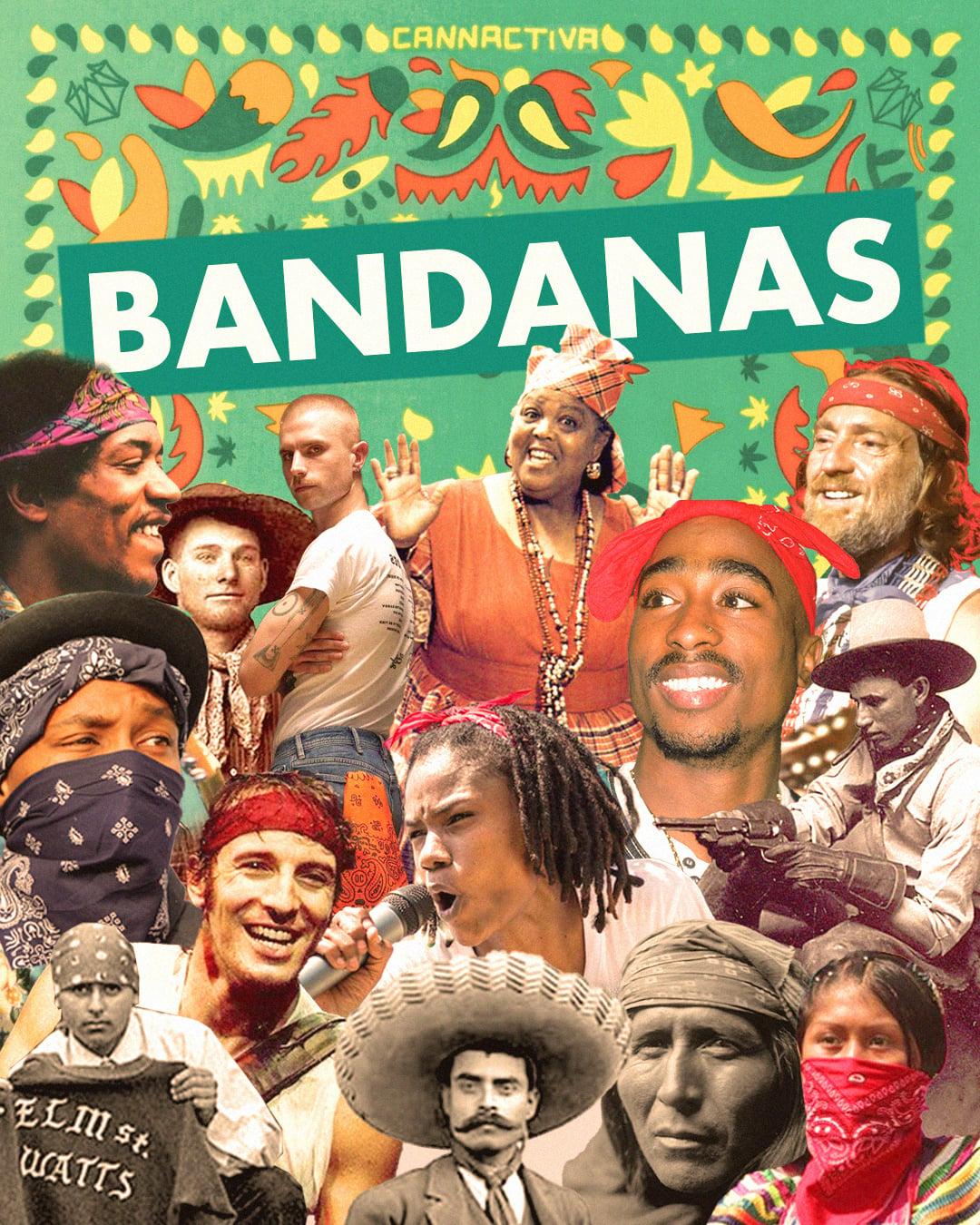
In rock, figures such as Jimi Hendrix and Axl Rose often wore it at their concerts, making it part of their iconic image. In 1990s rap, the bandana gained huge visibility thanks to artists such as the legendary 2Pac, who made it his personal trademark and a symbol of identity and neighbourhood pride.


Other iconic artists made the bandana part of their personal look, using it as a distinctive element of style. In American rock and country, figures such as Elvis Presley, Bruce Springsteen and Willie Nelson made it an inseparable part of their image. In hip-hop and rap there was Snoop Dogg, and in pop and soul, artists such as Amy Winehouse, Christina Aguilera, Cher and Madonna adapted it to their own styles, from retro pin-up to the urban look of the 2000s.
Their appearances helped to cement the bandana's image as a versatile accessory, able to adapt to different eras, music genres and cultural movements, reaffirming its place as a global icon.
Today, the bandana keeps turning up in music videos, at festivals and on catwalks, proof that this accessory has not only stood the test of time but keeps reinventing itself as a cultural and aesthetic symbol.
After this journey through the history of the bandana, it's impossible not to see it with new eyes. The next time you put one on, it won't simply be one more accessory: you'll be carrying a story woven from centuries of resistance, identity and struggle. You'll be carrying with you the voices of those who came before, who used this simple piece of cloth to say “here I am”, to claim their dignity, their culture and their right to exist.
At Cannactiva we believe fashion can also be memory. That's why we wanted to pay tribute to this legacy with a limited edition of exclusive Cannactiva bandanas. A unique piece from our art collection that reinterprets this ancestral symbol, keeping elements of the original design to honour its essence and its history. The exclusive bandana illustrated by Zosen is much more than style: it's a garment full of history and value.