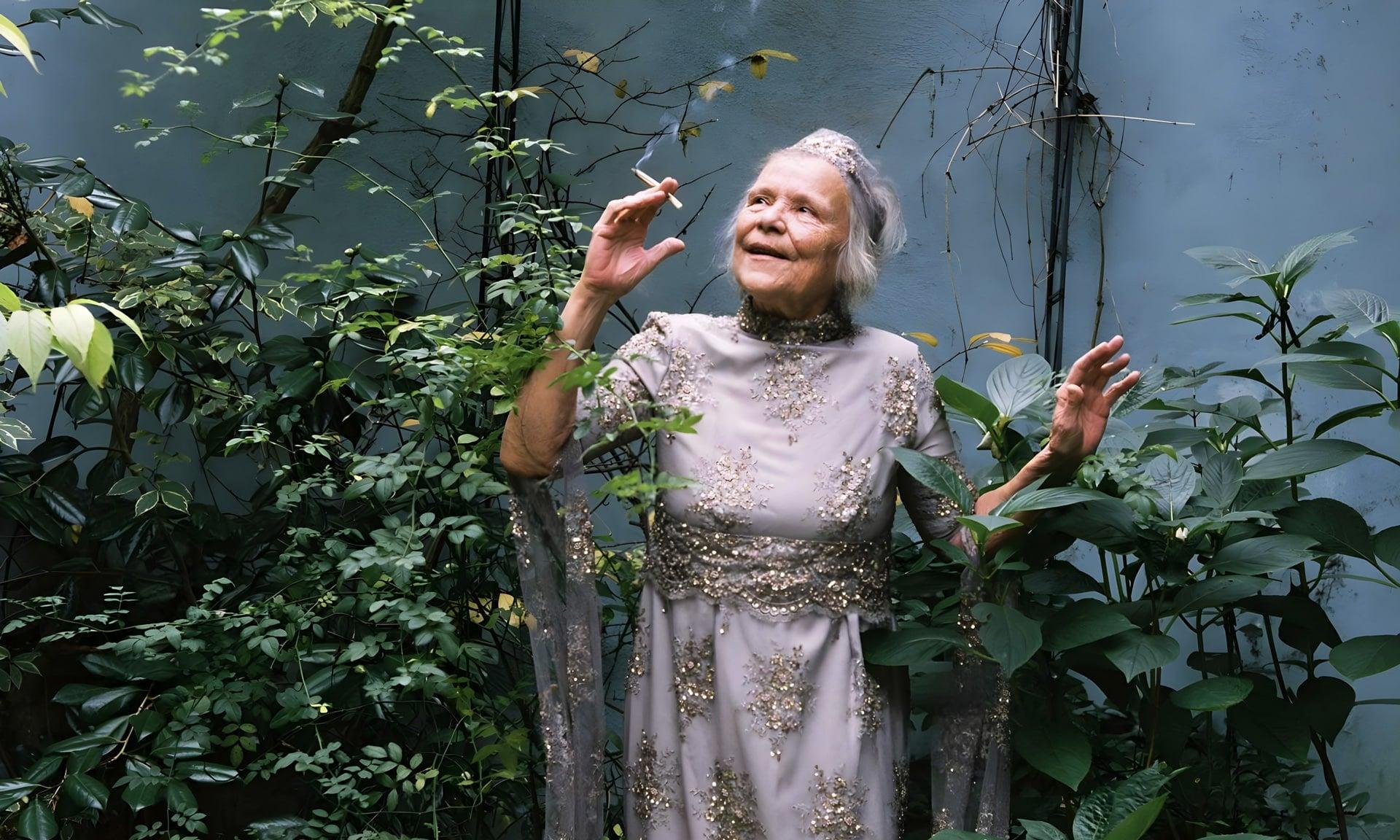
At 78, Mila Jansen is probably the most important woman in the cannabis world. She is known as the Queen of Hash. A pop icon in 1960s Amsterdam, entrepreneur, smuggler, mother and hustler, she is the inventor of the high-quality resin extraction systems the Pollinator, the Ice-O-Lator and the Bubbleator. The story of a daughter of the forest who carried the secrets of cannabis from Asia to the whole planet.
The story of Mila Jansen: one of the most important figures in the history of cannabis
If there is such a thing as destiny, then life — or the cosmos, or whatever it is that orchestrates our magical existence — had a throne prepared for little Mila even before she was born in post-war Liverpool.
Daughter of a forest
Mila is the daughter of a forest. And that shaped her story: a thread of adventures marked by plants, flowers, travel, freedom and, above all, cannabis as her final destination — the crown of her kingdom.
A thousand lives fit inside the life of Mila Jansen. Daughter of a forest? On a snowy mountain in the state of Saint Louis, in the United States, during the dreadful winter of 1943, someone, by pure chance, found the young Dutch woman Ilona van Hall, half-frozen, surrendered to death by her own choice. Her mind had stayed trapped in the memory of a friend — perhaps her love — murdered by the Nazis during the German invasion of Amsterdam. The terror was such that her father, hoping to save her, had immediately sent her by ship to the other side of the Atlantic.
But Ilona could not bear being so far away. She walked deep into the trees and the snow to let herself be carried away forever. She failed. She was lucky. Someone saw her and rushed her to a hospital. And there, another twist of destiny. In that very place she met Hans Jansen, an executive twenty years her senior who was also a patient there, a Dutch survivor of the Second World War. Within a few months the couple were married and back in Europe where, in the autumn of 1944, Mila arrived — named after the nurse who had brought her parents' paths together.
It was a world about to change forever. And it would be Mila's generation that held the reins of a new social paradigm in which the celebration of life, of youth and experimentation with drugs would shape the character of the culture in the second half of the 20th century.
How she became the Queen of Hash
Sooner rather than later, Mila Jansen would become one of the most important women in the modern history of cannabis. First with her iconic tea house on the Amsterdam underground scene, and later thanks to the wisdom she gained from living two decades in Asia, where she came to know the secrets and mysteries of hash like no other Westerner.
Half a century after her birth, Mila Jansen, by then the mother of four children, had a revelation while watching the drum of her washing machine spin.
She had already walked the villages of India and had already been a pop figure in the Netherlands. In Afghanistan she had learned the charas method: separating the trichomes from the leaves and flowers of the cannabis plant by rubbing them by hand, one way of making hash. And then, eureka: if she adapted the washing-machine mechanism to the ancient idea of the peoples of southern Asia, she could put buds in and get resin out.
And so Mila invented the Pollinator, the first mechanical resin separator, the first electric hash factory, with which she definitively became a reference point for the budding cannabis industry that was timidly and clandestinely emerging in old Holland.
The Pollinator method works like the drum of a tumble dryer, only instead of separating dirt from clothes, it knocks off the cannabis trichomes.
“People had been making hash by hand for thousands of years in countries like Afghanistan, Iran and Pakistan. That's why I'm the queen. Because it was the first time people could make their own hash without spending hours doing it”, she often repeats in press interviews.
By the time of her revelation and the Pollinator, Jansen was already one of the main hash suppliers to the coffee shops of Amsterdam. She had large indoor grows hidden from the police. Mila's resin was so good that, at first, many outlets didn't even want it because they thought it was too strong, too powerful.
The life of Mila Jansen
The first joint
The first time she tried a joint was in late 1964, at the age of 20. “From that moment on, it became my drug of choice. In those days there was no weed in Amsterdam, so it was a hash joint, and that's what I've smoked for more than 50 years”, the Queen recalls. Around that time, she would become a celebrity with the opening of her clothes shop “Kink 22”.
From clothes shop to tea house
It was a wild time for the Dutch capital. After spending a little over a year as the favourite clothes shop of the top models, after welcoming celebrities like Tina Turner and becoming a beat icon, in November '67 Mila and her partners turned the fashion business into a tea house they called Cleo de Merode, in honour of a dancer who was a friend of Mata Hari.
Cleo de Merode was not a coffee shop, but it is considered the first coffee shop. Inside, in a space decorated with Persian rugs, golden bars and low tables, there was an air of absolute freedom, along the path set by figures of late-60s youth culture such as Bob Dylan or Timothy Leary.
The fitting rooms became private spaces with cushions. Everyone could smoke whatever they liked, and there was always a spliff of tobacco and hash going round the tables. “It was never the first coffee shop because we never sold anything; we just shared the hash that came from Turkey, Lebanon and even Afghanistan”, she explains.
Mila's escape to the land of cannabis
However, it wasn't long before the local police received complaints from neighbours, and so its creator decided to leave with her little girl. The police had threatened to report her to social services and take her daughter away. So, at 24, Mila went into exile far from Holland. It was the start of a journey through the East that lasted 14 years, during which she would have three more children.
“A wonderful part of my life. In summer I walked in the Himalayas with my four children, and in winter we spent time in Goa”, Mila said. They were years of very little money, and some of what she got together came from sending hash to Europe in the same bags she used to export clothes made by local weavers. She met the sadhus and smoked chillums of hand-rubbed hash. She even spent time in Tibetan monasteries. She was in the original land of cannabis culture, and she made the most of it.
Mila's return to Amsterdam
Because of health problems with one of her children, Mila decided to return to Amsterdam a decade and a half later. She quickly found in cannabis growing not just a way to earn a living but also a calling.
It wasn't hard for her to get a job in the cannabis industry because she had always known she had green fingers, like a true daughter of the forest. When she was seven, after living in several countries because of her father's work, her family moved to a house with a garden in Essex, in the United Kingdom. “How I loved spending time with my mother working in the garden! In summer I picked baskets full of flowers (...) It was a wonderful garden to grow up in; it was full of secrets”, Mila wrote in her more than interesting book How I Became the Hash Queen.
Unlike 14 years earlier, Amsterdam was now full of weed and of coffee shops that needed a constant supply. So she set to work doing what she loved.
“I started by making cannabis clones, and a year later I started my own eighteen-lamp grow. It went well and I was able to pay all the school fees. In the end, with friends, we had thirteen grows in Amsterdam, but these places come and go; even the wonderful greenhouse I worked in in '92 didn't last. We lost 24,000 plants ten days before harvest”, she recalled. She was the first strong woman in an underground industry completely dominated by men, but once again the police appeared as a threat to her freedom.
Mila's coronation as the Queen of Hash
Once again, for Mila the crisis was an opportunity: police persecution led to her coronation. When she stepped away from the illegal business, Jansen received from the cosmos the inspiration to invent the Pollinator, and shortly afterwards she invented the Ice-O-Lator, an innovative method for making resin with water and ice.
Her invention gave rise to an entirely Dutch hash, pressed and dry, known as “neder hash”. And she took, forever, the throne of Queen of Hash.
Everything Mila owes to cannabis, the plant also owes to her. What we give, we receive: Jansen knows it, we all know it. “Hash keeps me healthy and sane in the face of all the madness life brings”, the Queen often says. She is almost 79 and still as radiant as a freshly cut flower.
Mila Jansen's legacy in the CBD hash we sell today
The Pollinator and the Ice-O-Lator did not stay in Amsterdam: they changed forever the way hash is made all over the world. Today, when we make our CBD hash at Cannactiva — the dry-sifted pollen, the classic pressed hash, the iceolator made with water and ice — we follow the same artisanal principles that Mila popularised. These four hashes are the closest to the spirit of the Queen:
Frequently asked questions about Mila Jansen
How old is Mila Jansen?
Mila was born in Liverpool in autumn 1944, so she turns 82 in 2026. She still runs Pollinator Company and makes appearances at international cannabis fairs.
What's the difference between the Pollinator, the Ice-O-Lator and the Bubbleator?
All three are her inventions for separating trichomes, but they use different principles:
- Pollinator (1994) — mechanical drum, dry sifting. Produces pollen / dry sift.
- Ice-O-Lator (1998) — manual filter bags, water + ice. Produces iceolator of maximum purity.
- Bubbleator — motorised version of the Ice-O-Lator. Lets you process large quantities without stirring by hand, while keeping the same quality.
Did Mila Jansen invent bubble hash?
Yes, in practice. Before her Ice-O-Lator (1998), water-and-ice extraction was a homemade technique with no standard method; Mila was the first to industrialise it with a kit of graduated filter bags. The term “bubble hash” became popular later thanks to Bubbleman, but the method and the equipment that make it reproducible are hers.
What is “neder hash” and why is it associated with Mila Jansen?
“Neder hash” (from Nederland, the Netherlands) is hash made entirely in Holland from plants grown there, pressed and dry. Before Mila's inventions, almost all the hash going round Amsterdam came from Morocco, Lebanon or Afghanistan. The Pollinator made it possible, for the first time, to produce quality hash without importing anything, and with that a whole Dutch school was born.
Where is Pollinator Company today?
At Grasweg 41D, 1031 HW Amsterdam (in the Noord district, a 10-minute ferry ride from Central Station). It is at once a factory, a head shop and Mila's personal archive — a cannabis library, historical machines and, if you're lucky, a cup of tea with the Queen if she's around. Open Monday to Friday, 11:00 to 18:00.
What book did Mila Jansen write?
Her autobiography is called How I Became the Hash Queen (also published in Spanish as Cómo llegué a ser la reina del hachís). It tells the whole journey first-hand: Liverpool, Cleo de Merode, the 14 years in India and Afghanistan, what she learned from the sadhus and in Tibetan monasteries, the clandestine Amsterdam grows and the exact moment when, watching the washing machine spin, she came up with the Pollinator.
Start here: CBD hash to discover Mila's universe
If you're keen to try what Mila set in motion three decades ago, the easiest way is to start with our CBD Hash Pack: the four house hashes in a single bundle to compare textures, flavours and extraction methods. Or go straight to the iceolator and the pollen, the two hashes that best capture the spirit of the Queen of Hash's inventions.