In this post we tell you about the scientific studies that show the promising properties of CBD or cannabidiol for hair growth.
This hemp compound acts on the hair follicle through the skin's endocannabinoid system, and has benefits for scalp and facial hair care (eyebrows, moustache, beard, sideburns). Cannabidiol also has anti-inflammatory and antipruritic properties to relieve itching and inflammation after shaving or hair removal.
That is why CBD or cannabidiol will very probably be one of the next trends in skincare and hair treatments: from products for hair growth, baldness and beard care to aftershave and post-hair-removal products.
Cannabinoids and their relationship with hair
Understanding hair structure: the hair follicle
The part of the skin where hair grows is called the hair follicle. It is a structure that functions as a miniature organ, composed of epithelial and mesenchymal tissue.
Together with the sebaceous glands, the hair follicle is part of the pilosebaceous complex, which is extensively regulated, with complex communication systems that are not yet fully understood.
Endocannabinoid system in the scalp
The endocannabinoid system is a key player in hair growth. For those not yet familiar with it, the endocannabinoid system is a network of biochemical connections between the body's systems, which contributes to the wellbeing and care of its different structures. It is one of the body's most primitive cellular communication mechanisms, and it is vitally important for health, although it was discovered late and there are still many unknowns about it.
How can cannabis affect hair?
For scientists, clear evidence of the importance of the endocannabinoid system for hair is the presence of endocannabinoids in the hair follicle, such as AEA (anandamide) and 2-AG (2-arachidonoylglycerol).
The presence of hemp cannabinoids in the hair of regular cannabis users and users of cannabis skincare products has also been established (source, source).
It is easy to infer that cannabis compounds can have an effect on hair, and the first scientific studies confirm this.
There is a high level of scientific evidence showing that cannabinoid receptors are present in hair follicle cells and that cannabinoids have effects on hair growth and hair loss.
How is hair growth regulated with cannabinoids?
It appears that the types of cannabinoids that bind to CB1 cannabinoid receptors control hair growth, while those that block this receptor prevent hair loss. In addition, hair growth is regulated by vanilloid receptors 1 and 4, which are sensitive to CBD (source).
The endocannabinoid system also regulates inflammatory processes affecting the skin and the nourishment of the hair, as well as the production of sebum, the oils and fats that protect the hair.
Although it may seem new, cannabinoids are in fact already used for hair growth problems. One example is bimatoprost, derived from the endocannabinoid anandamide, which is a topical treatment for hypotrichosis of the eyebrows (source).
This same cannabinoid is also being investigated as a treatment for baldness, with good results in early clinical studies (source).
CBD for hair growth
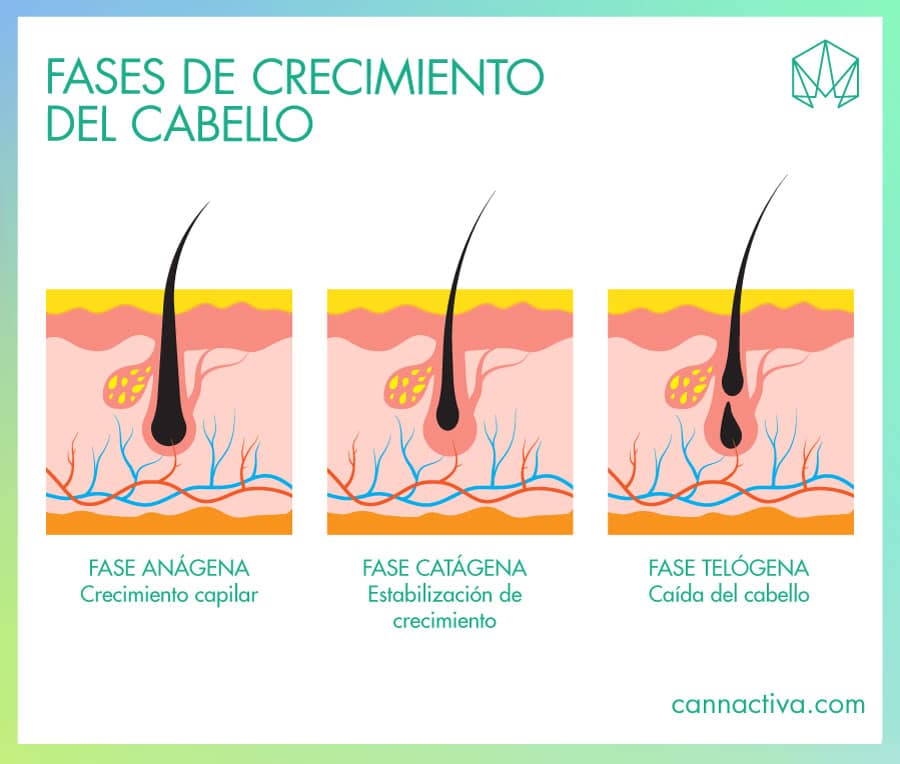
Hair growth cycle
To understand the effects of cannabinoids on hair growth, it is useful to briefly review the biology, popularly known as the hair growth cycle.
Hair growth is a complex, dynamic process which, put simply, unfolds in the following successive phases:
- Hair growth or anagen phase: lasts from 1 to 6 years, depending on the person. During this stage, hair grows steadily, approximately 1 cm a month. The hair root is thickened and deeply embedded in the dermis, completely filling the hair follicle.
- Hair growth stabilisation or catagen phase: lasts from 2 to 4 weeks, and is a stage of apoptotic regression of the hair follicle. In other words, the hair stops growing because the hair cells (keratinocytes) degenerate. The root loses volume and rises towards the surface of the scalp, separating from the dermal papilla and losing its blood supply, which will eventually cause it to die.
- Hair shedding or telogen phase: lasts from 3 to 4 months, a period in which the hair falls out naturally (pushed out by a new hair forming) or as a result of brushing or pressure (tight ponytails, rubbing against the pillow, caps, hats…).
- Finally, there may be a latency period, during which the follicle remains inactive, without hair, before a new anagen phase and the start of a new hair cycle. This happens if no new hair has formed after the hair has fallen out.
Hair growth and hair loss problems
Hair growth is affected by various factors, resulting in alopecia (lack of new hair growth), hirsutism or hypertrichosis (excessive hair growth).
The factors that can cause these imbalances are mainly the following:
- Stress: one of the most common causes of excessive hair loss. Researchers state that the hair follicle is extremely sensitive to emotional changes, which are always linked to hormonal changes. In these cases, it is best to relax first and review your lifestyle before looking for any magic solution.
- Genetic factors: baldness has a strong genetic component which, honestly, is very difficult to remedy.
- Iron deficiency anaemia, which causes hair loss.
- Hormonal changes, such as the menopause, pregnancy and the postpartum period (the latter also affected by stress and physiological postpartum anaemia). Certain conditions linked to hormonal imbalances, such as polycystic ovary syndrome (PCOS), can cause hirsutism or other hair changes.
In any case, when sudden changes in hair growth or hair loss appear, the first step should be to consult a professional. If you are losing a lot of hair, see your GP to assess the hair loss and diagnose the possible cause.
Effects of CBD on hair growth
How does CBD help hair growth?
Topical application of CBD reaches the hair follicle, where it acts on the cannabinoid receptors CB1, CB2, TRPV1 and TRPV4:
- It decreases the activity of the hair follicle's CB1 cannabinoid receptor, promoting hair growth.
- It binds to the vanilloid receptors TRPV1 and TRPV4, modifying the hair cycle.
- In small doses, it stimulates hair growth.
Could CBD increase hair loss?
It appears that the effects of CBD on hair growth are closely related to the dose. High concentrations of CBD could trigger premature entry into the catagen phase and slow hair growth, also via the TRPV4 receptor mechanism (source).
Scientific studies on CBD for baldness
Baldness or androgenetic alopecia is the most common cause of hair loss. It is caused by an increase in androgens or “male hormones” – although women also have these hormones naturally, men have them at higher levels – and mainly affects the crown and frontal areas.
There are many approved medicines for alopecia, but their effectiveness is limited due to the strong hormonal component, which is difficult to counteract. That is why the term “miracle hair restorer” has always been so popular, as finding a remedy for hereditary or genetic baldness is almost a miracle.
However, there are effective medical treatments for baldness, and within that professional context, CBD can be useful, as the first clinical studies on the subject show.
Clinical study on cannabidiol for baldness
A clinical study of 35 people with baldness applied hemp oil with CBD once a day for six months. The results showed a significant increase in hair, especially in men (it was also effective for women, but with a smaller percentage increase in hair count).
In the details of the study, the dose applied was 3-4 mg of CBD a day, together with other cannabinoids naturally present in full spectrum cannabis oil – pure CBD was not used, but rather a whole extract of the cannabis plant (Full Spectrum).
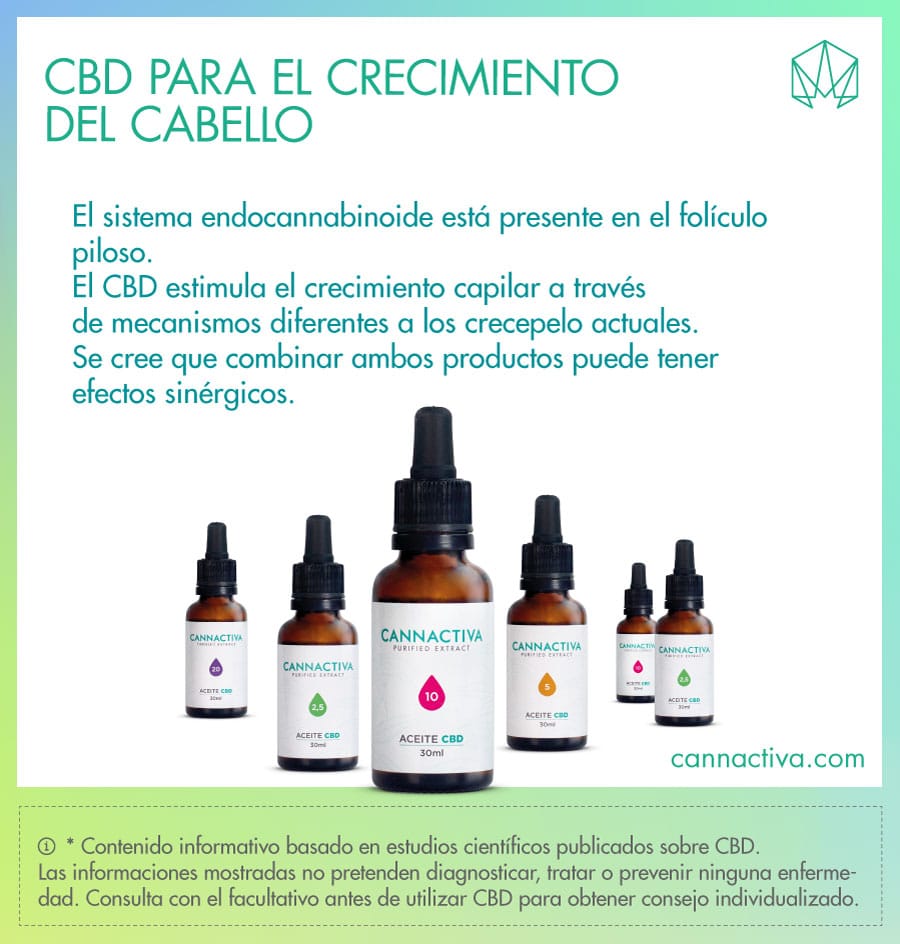
The researchers in this study concluded that since CBD works through novel mechanisms that differ from those of finasteride and minoxidil (hair growth drugs), it can be used alongside these current medicines, as it is expected to have synergistic effects (source).
Because CBD stimulates hair growth through novel mechanisms that differ from those of current hair growth drugs, combining the two may have synergistic effects.
In reality, the regulation of hair growth is much more complex, and its relationship with the endocannabinoid system still raises many questions.
Current scientific evidence points to a promising future for CBD and phytocannabinoids in the field of hair treatments and haircare products.
Hemp oil for hair care
Hemp seed oil also has hair care properties.
For those unfamiliar with the subject, hemp oil is the oil extracted from hemp seeds by pressing, in a similar way to how oil is extracted from other seeds, such as sunflower. Hemp oil differs from CBD because CBD is extracted from the plant's flowers (the buds) by distillation.
Hemp oil stands out for being rich in the nutrients omega-3 and omega-6, with a polyunsaturated fat content of 70%.
The skincare properties of hemp oil are well known. Applying it to the face and scalp will help keep the skin better hydrated, nourished and healthier.
Using CBD for hair
At Cannactiva we offer CBD oil, which combines organic hemp seed oil with full spectrum CBD extract, with all the properties of hemp cannabinoids.
We recommend trying this product for facial and body hair care: moustache, beard, eyebrows… If you are following a hair treatment for baldness, we advise you to consult your doctor or dermatologist about the optimal dose of CBD oil for your treatment, as well as whether it is suitable for you.
CBD for hair (FAQ)
Does CBD help hair grow?
CBD has effects on the hair follicle and could help with hair growth and hair loss, as well as with treating an itchy scalp and other related conditions.
How does CBD work for hair?
CBD appears to stimulate hair growth and could be a good hair treatment. It is worth noting the importance of the dose, as high concentrations of CBD could have the opposite effect.
Can CBD work as a hair restorer?
On its own, CBD is not a good hair restorer, and neither are many medicines. However, it works through different pathways from current hair restorers and could make a good combination. It is a subject that is currently being researched.