Bob Marley and cannabis: a redemption song
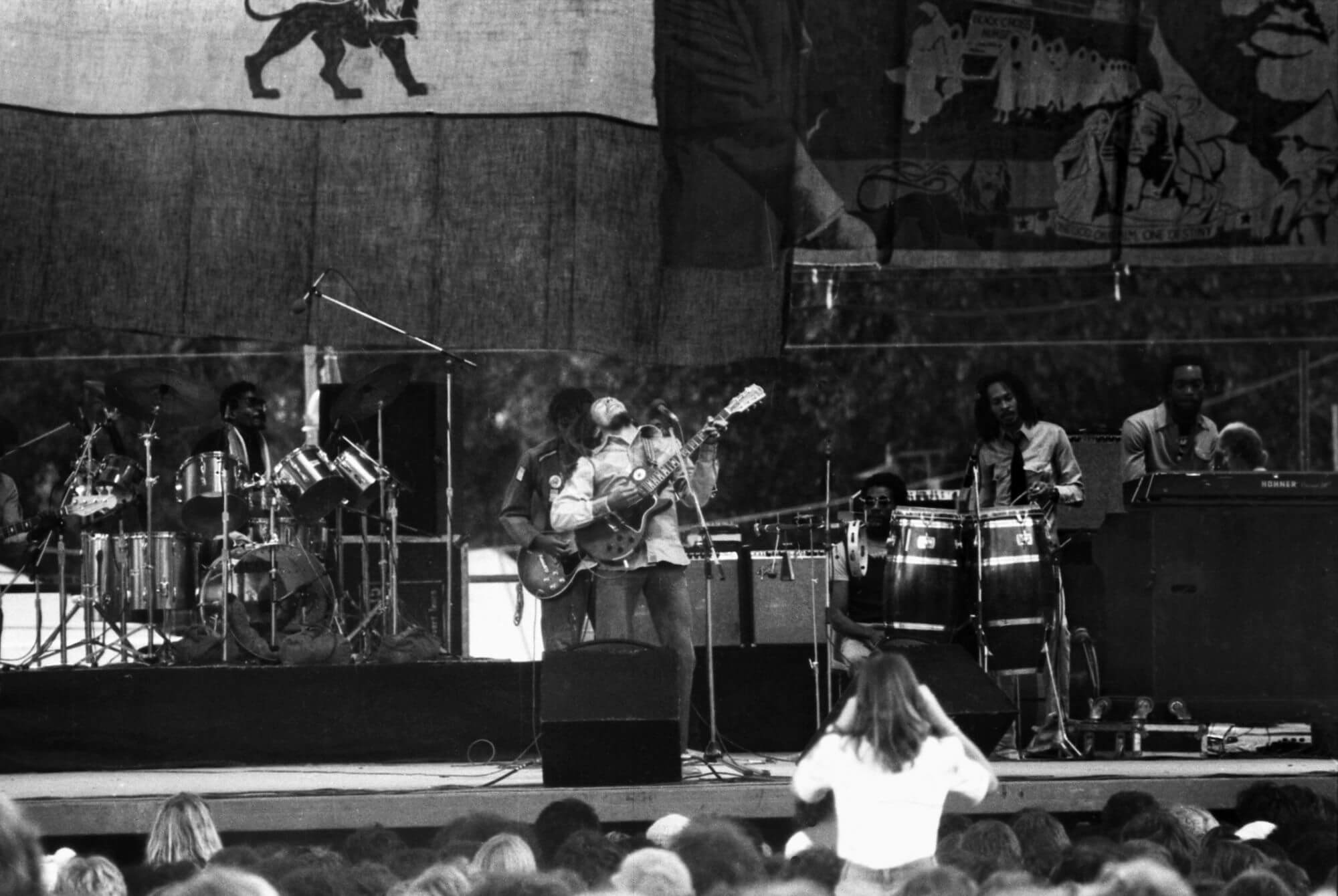
Bob Marley, the iconic Jamaican musician, not only left an indelible mark on the history of reggae music but also became a passionate advocate for the cannabis plant and for freedom. Through his songs and his words, Marley spread free, unprejudiced thinking about this plant all over the world.
To mark Bob Marley's upcoming anniversary on 6 February, today on the Cannactiva blog we look back at Bob Marley's life: his relationship with cannabis, his songs and his influence on how society perceives cannabis.
Bob Marley: the seed of free, unprejudiced thinking about cannabis
Wearing a red Adidas tracksuit top, his dreadlocks arranged for posterity, Bob Marley reflects while a flock of birds can be heard singing over his voice. Judging by the TV footage, it's a cloudy day, with a river and very tall trees in the background.
“You understand it in a sense, and suddenly you say: weed, weed is a plant! I mean, plants are good for everything. Why do these people who ‘want to do good’ for everyone, for each and every one, who call themselves ‘rulers’ and this and that, why do they say we mustn't use the plant?”
He is in New Zealand, the year is 1979, and the most important musician in the history of Jamaica, the man who took the rhythm of a small Caribbean island global and made it a worldwide craze, lashes out against the silence surrounding the taboo subject of a plant regarded as a drug. Eight years earlier, US President Richard Nixon had declared drugs, cannabis included, public enemy number one. Marley drives his point home: “I always have it in mind, and you hear them say ‘you mustn't smoke because it turns you into a rebel’. A rebel against what?”

6 February: Bob Marley's birthday
Robert Nesta Marley, who would have turned 79 on 6 February 2024 had cancer not taken him at 36, was a kind of cultural shaman. Through the extraordinary spread of his reggae songs, the arrival of his legendary personality in Europe and the frenzy his songs caused in North America, the musician sowed the world – like the winds over the desert – with the seed of free, unprejudiced thinking about cannabis.
Marley's religious connection with cannabis and Rastafari
Marley's relationship with the plant is a religious experience, rooted in his faith in Rastafari, a spiritual movement that emerged on the outskirts of Kingston, the Jamaican capital, in the early 20th century, with Africa at the centre of its belief. In essence, the movement is based on the idea that the Ethiopian leader Haile Selassie (known as Ras Tafari before he ascended the throne), who was said to belong to a dynasty descended from the biblical King Solomon, was the Messiah.
Sacramental use of cannabis in Rastafari belief
The sacramental use of the cannabis plant goes back thousands of years. Religions in India and China incorporated it into their mystical beliefs because of its medicinal properties (unknown in that pre-scientific age), and it is from there, from Hindu and Pan-African influences, that the Rastafarian link with cannabis stems. Rastafarians uphold the myth that the plant was found at the site of King Solomon's tomb. Although there is no evidence for this belief, for them the effect of THC opens their minds, deepens their inner connection and brings you closer to “Jah”, their god.
Marley as a spiritual figure and natural leader
Marley turned his art into a religious quest. In his day, Jamaica was going through political and social tensions, with deep economic inequality, poverty and political violence. Marley converted to Rastafari, a Jamaican religious movement that promoted racial equality and the sacramental use of cannabis.
He became the voice of the marginalised on a small island, and that voice then spread across the planet. In fact, the American journalist and collector Roger Steffens, perhaps his finest biographer, explains the phenomenon through a spiritual theory.
In his book “So Much Things to Say”, many of the interviewees who knew him portray him as an archetypal figure from Christian myth: a child born poor, the son of a white man and a black woman, and therefore discriminated against by both white and black people, who becomes a deeply spiritual person, a natural leader and also – why not – a prophet. “His live shows began to resemble gospel meetings, with a preacher and his (female) choir,” writes Steffens.
The evolution of Bob Marley & The Wailers
In 1963, when he was 18, Marley teamed up with Bunny Wailer and Peter Tosh to form the Wailing Wailers, who were joined by Junior Braithwaite and backing singers Beverly Kelso and Cherry Smith. They released the single Simmer Down, a ska song about Kingston's street gangs. Shortly afterwards they became The Wailers and, a couple of years later, Bob Marley & The Wailers.
With that project, Bob arrived in England in 1972 and was signed by the small label Island Records, owned by Chris Blackwell, a Jamaican music lover living in London. The businessman says he gave him £4,000 to record an album. “I never thought I'd get anything out of it, but four months later he came back with Catch a Fire,” he explained, talking about what would become Bob Marley & The Wailers' first album in Europe, the big bang of the legend.
The impact of “Catch a Fire” in Europe
The first 20,000 copies of the original 1973 vinyl had a sleeve designed by the artists Rod Dyer and Bob Weiner to look like a Zippo lighter. The top of the lighter flipped open and the record could be taken out. But the technology of the time did not allow it to be produced on such a massive scale, as it would have pushed the price up considerably, so in the end a photo was chosen for a simpler cover: a portrait of Marley smoking a joint.
The 1960s and 1970s were a time of social movements, protests and political change. Marley became a symbol of the struggle for equality and freedom, especially in the fight against racial oppression and economic inequality.
Bob Marley's music became a symbol of resistance and of the struggle for social justice all over the world, changing the perception of cannabis into that of a plant associated with peace, equality and spirituality, at a time when it was heavily criminalised as an illegal and strictly prohibited drug.
The attempt on Marley's life and his call for peace
In 1976 Marley incredibly survived a brutal assassination attempt on him and his band (presumably because of his pacifist political stance in a turbulent Jamaica). One of the 86 bullets fired grazed his chest and lodged in his arm.
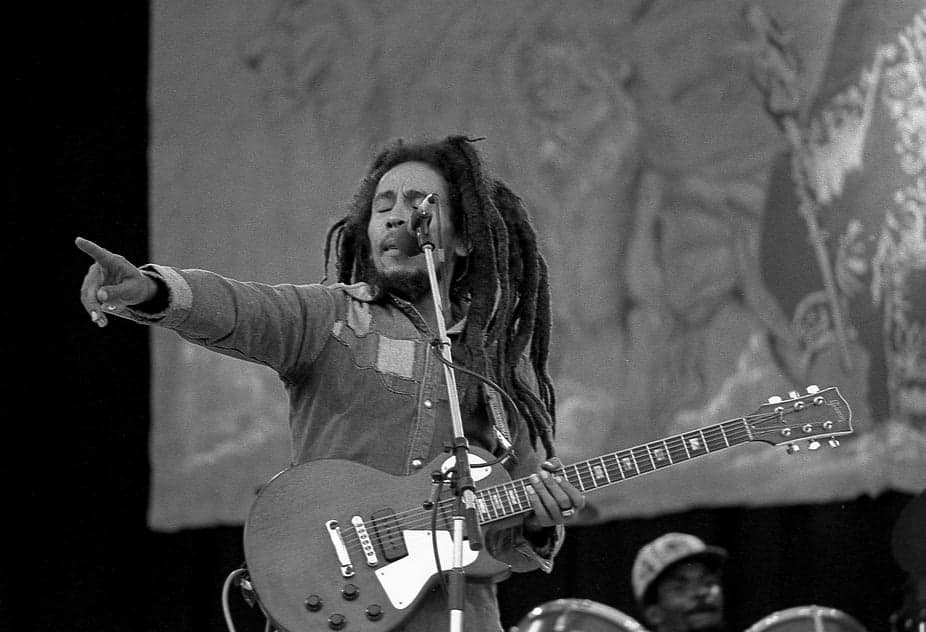
Two days after the shooting, his wounds still open, Bob appeared with his band at the Smile Jamaica festival, where once again he tried to call for peace. The concert went down in history and forced him into exile, first in Nassau, in the Bahamas, and later in London, where he settled for a year and a half. That was enough to change his career and his life, because there he wrote and recorded two key albums in his colossal body of work: Exodus (1977), which tells the story of that very exile, and Kaya (1978), written to love and (to the love of) cannabis.
Kaya: an album about the importance of cannabis to Rastafarians
The musical mood of Kaya reflects a more peaceful and harmonious state of mind, one that is easier to link to the effects of cannabis. It was precisely because he spent all day smoking joints that the police arrested Marley during his time in London. Marylebone Magistrates' Court found him guilty of possession on 4 June 1977 and fined him £50.
Kaya was, without doubt, a luminous response to the repressive police of the United Kingdom. “Excuse me while I light my spliff / Oh God, I gotta take a lift”, sings “Easy Skanking”, the opening track on Kaya, with a rhythm so mellow that just listening to it seems to take you on a cannabis trip.
In the album's title track, “Kaya”, Marley sings that the joint gets him so high “I even touch the sky”. It was originally recorded in 1971, produced by the wizard Lee “Scratch” Perry, when Marley was not yet the huge star he would later become.
It isn't a song about legalisation, but rather about the importance of “kaya” to Rastafarians: “Wake up and turn I loose / For the rain is falling / Got to have kaya now, got to have kaya now, for the rain is falling / I'm so high / I even touch the sky above the falling rain / I feel so good in my neighbourhood, so here I come again”.
“Cannabis was an important part of my father's spirituality and his music. He saw it as a tool for connecting with the divine and for promoting peace and equality.”Ziggy Marley, Jamaican reggae musician and son of Bob Marley
Kaya became Marley's highest-charting album of original material in the UK, reaching number 4. Some critics at the time suggested that Marley had somehow traded his supposedly unshakeable political convictions for an emotionally softer album, in order to become popular.
“Bob always defended people's right to use weed. He believed it set you free and let you see things from a higher perspective.”Peter Tosh, musician and Bob Marley's bandmate in The Wailers
However, Bob told Hot Press magazine when the album came out, back in 1978: “I never liked what politics really stands for”, adding that the new songs “don't really move away from anything, it's music, it can't be political all the time”.
The thing is, even if he played it down, Bob Marley was always a political man. It's no coincidence that his face became an icon of people's struggles, like Che Guevara's.
“A rebel against what?” Bob asks in 1979. More political than ever, he answers and hits the nail on the head: “They have material things and they want to captivate your mind until they tell you: ‘go to work and we'll give you a pension’. And they keep it all. So the weed makes you look at yourself, and instead of wanting to work for a boss, you want to be the boss, like ‘why do I have to bow down to this?’ The plant makes you see that you're your own boss, you own yourself for the first time. You do what you want, you don't care what people say about you.” Amen.
Bob Marley died on 11 May 1981 in Miami, Florida. He was 36 and had cancer, a malignant melanoma that started in his left foot. Although he was diagnosed in 1977, Marley refused to have an amputation, as it went against his Rastafari beliefs. He was buried in his birthplace, Nine Mile, in Jamaica. His body was laid in a mausoleum with a Gibson Les Paul guitar and a Bible. The exact location of his grave is a secret; perhaps someone brings him a cannabis flower every day to celebrate his time in the world of the living.