How to sleep better naturally: habits for restorative sleep

Sleeping well is one of the pillars of wellbeing, which is why today we bring you easy-to-follow tips that can help all of us improve the quality of our rest. And if you need some extra support, CBD for sleep is a natural option that more and more people are adding to their bedtime routine.
How to sleep better: practical, science-based tips for better sleep and rest
Sleeping well depends not only on what we do before going to bed, but also on the habits we keep throughout the day. These habits, known as sleep hygiene, are essential for creating the optimal conditions for deep, restorative sleep. Although they may seem like minor details, there is a biological logic behind them (pardon the redundancy), backed by science. In short: if you struggle to sleep, or if you want to sleep better, you need to start by improving the following habits.
Exposure to natural light in the morning
Light is the main trigger of circadian rhythms. Exposure to sunlight in the morning helps synchronise our internal clock, improving the quality of night-time sleep. Try to get some sun during the day to regulate your brain's circadian rhythm. For example, if possible, have breakfast outdoors or next to a window with natural light. At midday, if you can, go for a walk outdoors.
Sleep environment
Develop a relaxing bedtime routine with calming activities. Find your own routine that lets you unwind in the hours before bed: a hot shower, a nice-smelling cream, clean sheets, a little pleasant reading, a guided meditation…

Avoid exposure to artificial light in the evening
Artificial light in the evening and at night, especially the blue light emitted by electronic devices such as phones, tablets and computers, signals to the brain that it is still daytime, slows down the production of melatonin (the sleep hormone), makes it harder to fall asleep and reduces the quality of your sleep.
To counteract this effect, it is advisable to reduce your exposure to artificial light in the hours before sleep. In the evenings, keep dim, warm lighting indoors, preferably indirect. You can also use warmer lights at home, such as red light, which is less stimulating and therefore more compatible with the body's natural preparation for sleep.
Designing your bedroom
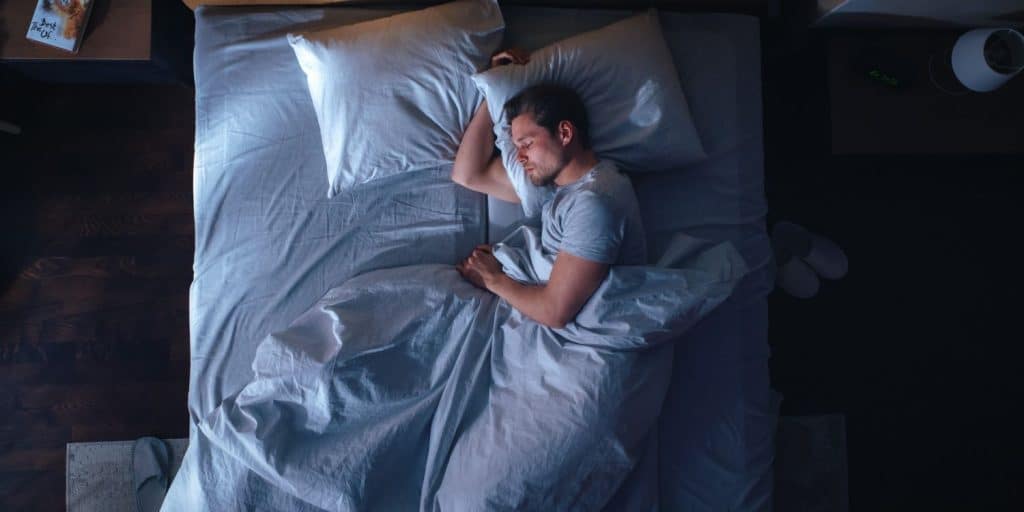
To ensure a good night's rest, your bedroom should meet certain conditions that favour sleep quality. First of all, total darkness is crucial. The room should be as dark as possible to promote the production of melatonin, the hormone that regulates sleep. If you cannot block out all outside light, an eye mask is recommended.
A drop in body temperature is an ancestral signal that it is time to sleep. Keeping the bedroom temperature slightly cool, between 16 and 20°C, helps lower your core body temperature, which makes it easier to fall asleep. This drop in temperature is a natural signal that the body interprets as time to rest. It is also advisable for the room to be free of noise and as quiet as possible. If you cannot control outside noise, earplugs can help.
On top of all this, take the time to make your bedroom a cosier place to sleep. That might mean changing the lighting, the decor, the sheets or the cushions, for example, depending on your preferences.
Have an early dinner to sleep better
At night, the body's digestive capacity decreases as it gets ready to rest, so eating late or having heavy meals can make digestion harder and affect the quality of your sleep. Having dinner early allows digestion to finish before you go to sleep, making for deeper, more restorative rest. The best thing for your body is to have dinner while it is still light, but if that doesn't fit your daily routine, it is best to have a light dinner of simple home-cooked food, avoiding fried food and processed food.
Nasal breathing for better sleep
Nasal breathing has many benefits, including better sleep and improvements in sleep apnoea. By contrast, breathing through your mouth causes dryness and throat irritation, and increases the risk of sleep interruptions, as well as snoring.
Avoid stimulants before bed
Avoid stimulant substances before bed, such as caffeine and nicotine, as well as alcohol. These substances can disrupt sleep patterns and affect your ability to fall asleep or stay asleep.
Activities that promote wellbeing
Do physical exercise and activities that promote wellbeing, and keep a positive, constructive attitude to life. Good levels of endorphins and endocannabinoids and low cortisol will make you feel better and help you rest. Relax, nothing is under control!
Physical exercise and better sleep
Regular physical activity helps improve wellbeing, makes it easier to fall asleep and improves both the duration and the quality of sleep. Exercise also lowers stress and anxiety levels, which contributes to better rest too.

Limiting naps
Long naps during the day can interfere with night-time sleep. If you need to sleep during the day, try to keep your nap short (20-30 minutes) and early in the afternoon.
Consistent routine
Going to bed and getting up at roughly the same time, even at weekends, is key to keeping your circadian rhythms regulated. This habit helps your body know when it is time to sleep, which improves sleep quality.
The circadian rhythm: how it affects your sleep and how to synchronise your internal clock
We all have an internal clock inside us that prepares our body for the daily cycle of day and night. This is what is known as the body's circadian rhythm, and at a biological level it consists of hormonal changes that occur cyclically, every day. These rhythms follow a cycle of roughly 24 hours (“about a day”, hence circadian) and are strongly influenced by external factors, especially natural light.
Over millions of years, we have evolved by adapting to the cycles of day and night, light and dark. It is crucial to understand that our biology is deeply adapted to these cycles, and that it is something we have imprinted in our genetics. Therefore, in order to sleep better, it is essential to respect and encourage these rhythms through such seemingly simple habits as, for example, having an early dinner and avoiding bright white lights at home at bedtime.
Circadian rhythms are not habits that can be modified: they are an evolutionary adaptation imprinted in our DNA.
Evolutionarily, circadian rhythms provide an advantage by allowing the body to anticipate and prepare for different biological functions. For example, the digestive system is most active during the day, when we are most likely to eat. In contrast, during the night, the body focuses on other functions, such as cell repair and tissue regeneration. This internal clock synchronises the body with the natural cycles of light and dark, and helps us to be more energy efficient.

Constant exposure to artificial light and a lack of synchronisation with the natural cycles of light and dark can throw these natural internal rhythms out of sync, causing sleep problems and sleep disorders. Find out how to synchronise your internal clock and which supplements work best, according to science, to improve sleep quality naturally.
What are the risks of sleeping badly?
Lack of sleep not only affects daily wellbeing, causing fatigue, memory lapses and lack of concentration, but is also linked to an increased risk of almost all known chronic diseases. In addition, it interferes with the body's ability to gain muscle mass and lose fat.
For all these reasons, when we ask ourselves how we can improve our rest, or how to sleep better, the first thing to address is the factors that support the circadian rhythm. More essential than any supplement!
Natural products to improve sleep
Although improving sleep habits is essential, some supplements may be helpful if sleep problems persist.
CBD oil for insomnia
CBD oil may be advisable if insomnia is linked to anxiety or stress. The usual approach is to start with a low dose – a few drops under the tongue, around 30 to 60 minutes before bed – and adjust it gradually until you find the amount that works best for you. We explain it in detail in our guide to CBD for insomnia.
Melatonin for sleep
Melatonin is a hormone that regulates the sleep-wake cycle. It is produced naturally by the body, but is also available in supplement form in most European countries.
Taking melatonin supplements is effective for sleep, and can be particularly advisable in certain situations. For example, for people who work night shifts or rotating shifts, to help them sleep well during the day and to get back to sleeping at night when they return to normal hours. Melatonin acts quickly, so it is best taken just before going to bed.
We hope you found this article useful and that you can incorporate some of these practical tips into your routine to improve your rest. Good night, and sweet dreams, Cannactivist!
References
- Pandi-Perumal SR, Cardinali DP, Zaki NFW, Karthikeyan R, Spence DW, Reiter RJ, Brown GM. Timing is everything: Circadian rhythms and their role in the control of sleep. Front Neuroendocrinol. 2022.
- Lee Y, Field JM, Sehgal A. Circadian Rhythms, Disease and Chronotherapy. J Biol Rhythms. 2021.
- Hirshkowitz M, Whiton K, Albert SM, Alessi C, Bruni O, DonCarlos L, Hazen N, Herman J, Katz ES, Kheirandish-Gozal L, Neubauer DN, O'Donnell AE, Ohayon M, Peever J, Rawding R, Sachdeva RC, Setters B, Vitiello MV, Ware JC, Adams Hillard PJ. National Sleep Foundation's sleep time duration recommendations: methodology and results summary. Sleep Health. 2015.
- Zhao J, Tian Y, Nie J, Xu J, Liu D. Red light and the sleep quality and endurance performance of Chinese female basketball players. J Athl Train. 2012.