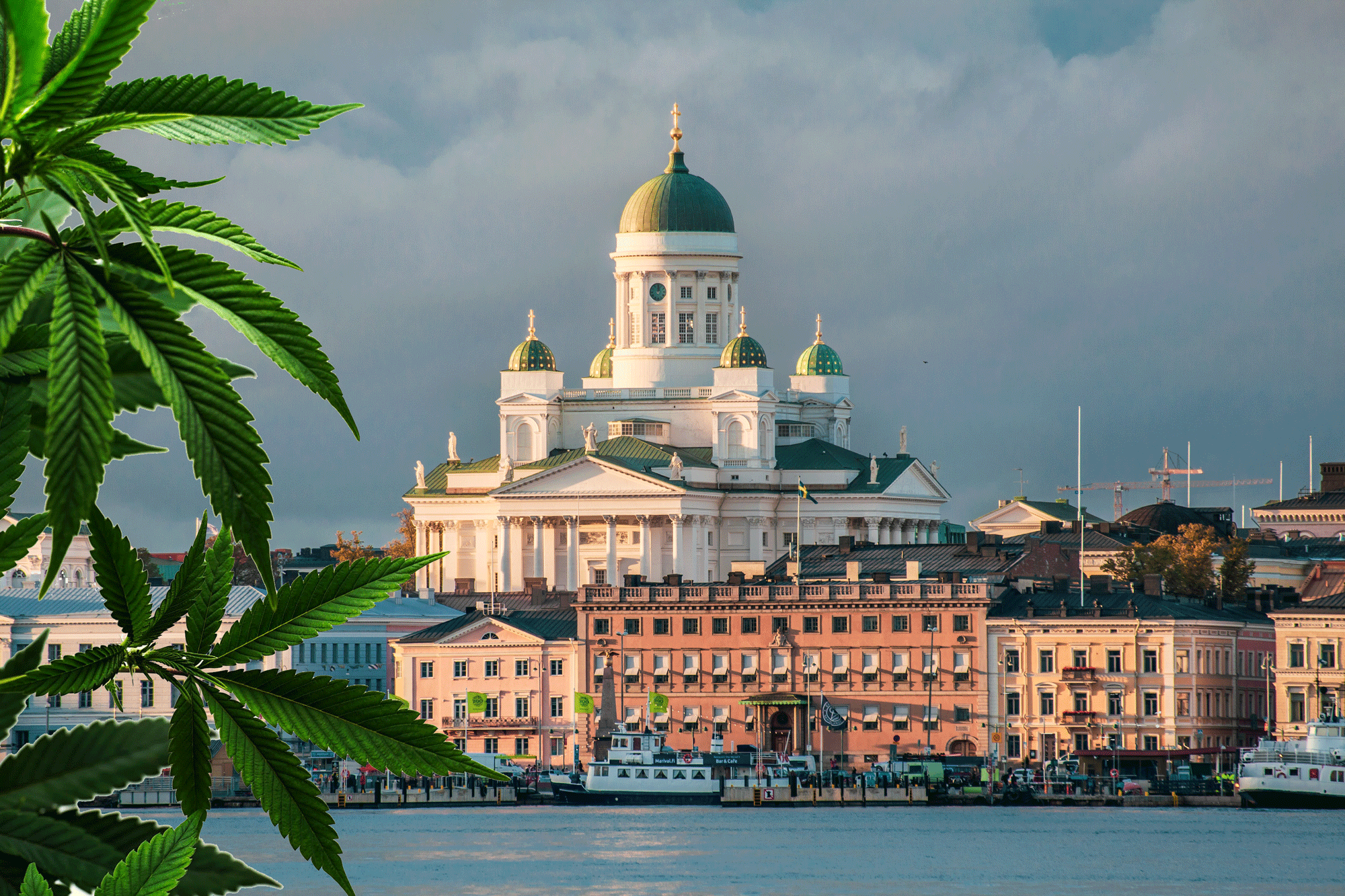
Scandinavian countries are known for having some of the strictest policies on cannabis. How is CBD regulated in these countries, and are there any changes on the horizon, as in other parts of Europe? To find out more, I spoke to an anonymous source living in Finland.
Is CBD legal in Finland and, if so, in what forms and under what laws? What about other Scandinavian countries?
CBD is not legal for consumption, but it can be sold as a cosmetic, in scent sachets, etc. Most of the time, people buy it in cosmetic products, in the form of creams or drops. Edibles are not allowed for consumption. Some shops in the major cities (mainly in the capital region) sell CBD flower, but it cannot be marketed for smoking or vaporising. As far as I understand, the situation is fairly similar in other Scandinavian countries, although I’m not sure whether CBD flower is permitted.
Does this mean it is legal to sell CBD-rich flower with less than 0.3% THC in Finland, but customers can’t consume it?
The limit in Finland is 0.2% THC. It is unclear how the law should be interpreted, i.e. whether hemp products below the legal THC limit can be sold freely. At present the authorities do not appear to object, but there are pending court cases in which CBD flower slightly over the THC threshold has been sold, which has been a problem.
Are there many CBD shops in big cities? Do you have any idea, for example, how many there are in central Helsinki?
There are fewer than ten CBD shops in the whole country, mostly in Helsinki.
Do you have any estimate of how many Finns use cannabis or CBD products?
This is practically impossible to estimate; there are no official statistics available on it. My guess is anywhere from a few thousand to tens of thousands.
What is the policy on “recreational” cannabis containing more THC in general in Finland and other Scandinavian countries?
By law, “high-THC” cannabis for recreational use carries a fine, even in small quantities. In practice (in the capital region), possession of less than ten grams is fined without court involvement (similar to a minor traffic accident). In less populated areas, the procedures are harsher and there is usually a court hearing even for relatively small amounts (less than ten grams). Production and trade in quantities of several kilograms can lead to prison sentences.
How widespread is THC use, and is it rising or falling? What about young people?
Consumption of “high-THC” products (mainly flower) has risen significantly over recent decades, especially among young people. I see the same trend continuing for the foreseeable future. What is interesting is that the flower on the market is mostly grown locally in Finland.
In Finland, there is no talk of legalising cannabis, whether medical or recreational, at the highest political level.
Is medical cannabis legal in Scandinavia? How does it look on paper and in practice?
It is legal in all Scandinavian countries, but it is not very common in any of them. This is mainly due to doctors’ reluctance to prescribe it. It is notoriously difficult to get a prescription in Finland for practically any medical condition. And if you are lucky enough, you usually only get Sativex spray. Although I have heard that Bedrocan flower has been prescribed in some rare cases. Even in Denmark, where growing medical cannabis has been permitted under licence in unlimited quantities since 2018, the number of prescriptions issued by doctors is very modest. This, again, is due to doctors’ very negative view of cannabis.
Doctors are reluctant to prescribe medical cannabis.
So can I get medical cannabis, for example for chronic pain, in your country?
In theory, yes, but in practice it’s very difficult.
Are there any trends we should be aware of? Are Finland and your neighbours going to legalise and regulate cannabis in the near future, or should we expect a move in the other direction?
There is no talk of legalising cannabis, whether medical or recreational, at the highest political level in Finland. It is very unlikely that Finland will be among the leaders in cannabis liberalisation. In my opinion, there would have to be changes to the EU and Schengen treaties before Finland would even consider legalising recreational cannabis. A functioning medical cannabis system similar to Germany’s in terms of prescriptions and production is also a long way off. The main obstacle is the doctors. For their attitudes to change, I think there would have to be compelling evidence that cannabis works better than any other medicine for a certain condition. I believe this holds true in all Scandinavian countries.
The only positive development that could be seen in Finland is home growing of a few plants for personal use. However, I don’t think cannabis clubs will be allowed in the foreseeable future. Again, I believe this is also true for the other Scandinavian countries. The only exception is Denmark, which could follow Germany’s lead in a few years.
Legal status of CBD in Sweden and Norway
The regulatory framework around CBD in Sweden, as in neighbouring Norway, is notoriously strict. The Swedish Medical Products Agency (Läkemedelsverket) classifies CBD as a prescription medicine, regardless of its source, whether derived from hemp or cannabis. Its interpretation of the European Union categorisation is strict, subjecting CBD to rigorous approval processes before it can be legally marketed as a food supplement or medicine. Only two CBD-based medicines are approved for sale in Sweden: Epidyolex (CBD) and Sativex (CBD and THC).
CBD oils without medical approval are banned from sale. When travelling with CBD, it is important to bear in mind that full spectrum CBD oils often contain THC. CBD is treated as a medicine, while THC is classified as a narcotic. Oils containing both CBD and THC (even in a low proportion) are considered narcotics, with legal consequences. In addition, CBD edibles fall under the jurisdiction of the Swedish Food Agency. While some European countries have taken a more lenient approach to CBD, Sweden’s stance remains rooted in its strict interpretation of the regulations.
Neighbouring Norway mirrors Sweden’s approach to CBD. In Norway, CBD is mainly classified as a medicine. The sale and distribution of CBD products for general consumption is prohibited without specific authorisation from the Norwegian Medicines Agency (Statens legemiddelverk, since 2024 Direktoratet for medisinske produkter). This means that CBD products are largely inaccessible to the average consumer without an explicit medical need.